
Jordan has a hospitality culture that makes the word feel insufficient. The concept of diyafa — the obligation to welcome a guest regardless of inconvenience — is not a cultural curiosity here. It is a living practice: the tea pressed into your hands at a shop you were only browsing, the family insisting you share their lunch at a Wadi Rum viewpoint because you happened to be standing nearby, the guesthouse owner driving you to the trailhead at 5am because he decided independently that you should see the sunrise from that ridge. Jordan gives the Middle East a good name with people not yet sure how they feel about the Middle East — entirely through the quality of what it offers and the warmth with which it offers it.
Petra: The City That Earns Every Superlative
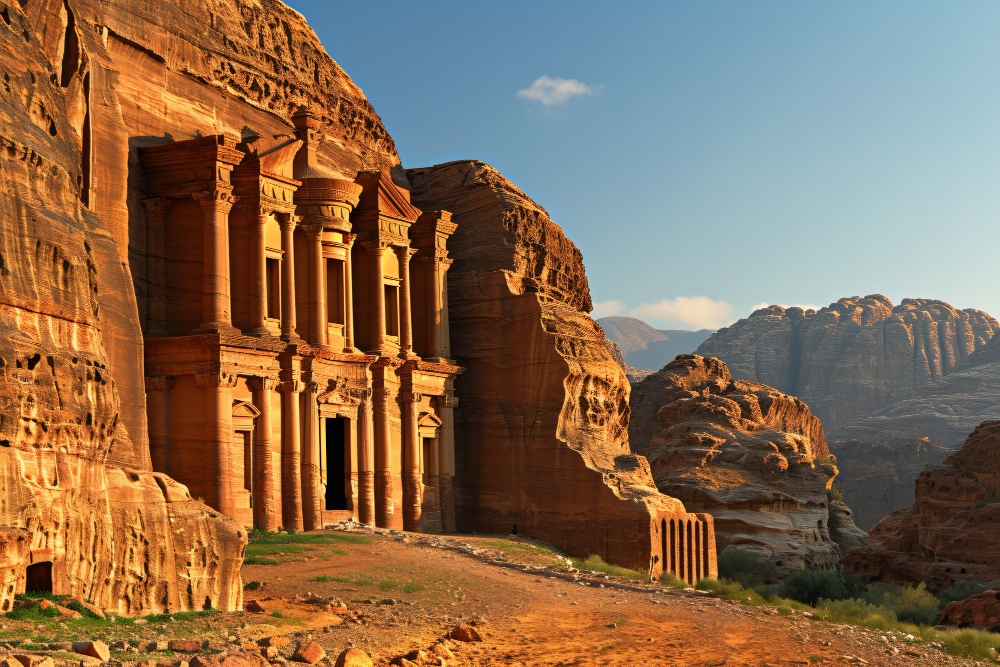
Petra is approached through the Siq — a kilometre-long natural crack in the sandstone, barely wide enough for two people to walk abreast, its walls rising 80 metres on either side, the light changing from bright to shadowed to bright as the crack narrows and widens. You walk it for about twenty minutes, your anticipation building with every corner, until the crack narrows to its tightest point and then opens suddenly onto a view of the Treasury — the Al-Khazneh, a 40-metre carved rock facade in rose and cream sandstone, entirely intact after two thousand years, filling the frame so completely that the first response is silence. The second response is to take a photograph that will not capture it. The third is to understand that some experiences are simply not transferable and this is one of them.
Petra extends 60 square kilometres — the Treasury is merely the entrance. The Monastery, two hours up from the Treasury through the ancient city, is larger, more isolated, and by most accounts more extraordinary, with a terrace view over the Jordanian highlands to the desert below. Take the steps slowly. Stop at the tea stall halfway up, operated by a man who has been making tea on that staircase for years and pours it with exactly the ceremony it deserves.

Wadi Rum: Sleeping Inside the Landscape
Wadi Rum provided locations for Lawrence of Arabia, The Martian, and Rogue One — and earns every cinematographer who has pointed a camera at it. Red sandstone formations rising 600 metres from a flat desert floor of ancient silence have a quality of improbability that does not diminish on acquaintance. Spend a night in a Bedouin camp where signal disappears and the fire is the only light. The night sky — free of light pollution for sixty kilometres — reveals the Milky Way not as a smudge but as a structure, something architectural, hanging above the desert with a clarity that makes the word “cosmos” suddenly accurate.

The Food: Simple, Generous, Impossible to Replicate
Jordanian food is built around mansaf — the national dish, a vast communal platter of lamb cooked in dried yoghurt sauce over rice and flatbread, eaten by hand from a shared tray — and around the principle that the size of the meal reflects the respect of the host for the guest, which means that meals in Jordan are large. The mezze — hummus made with dried yoghurt rather than tahini, falafel made fresh rather than reheated, maqluba (upturned rice with vegetables and lamb) — is the category that captures most travellers, alongside the bread baked in the taboun clay oven and the mint tea that arrives, as in all of the Levant, as both a greeting and a conversation.
Jordan is a small country with an enormous amount to offer and a culture that treats the traveller as a guest rather than a revenue stream. This distinction, in 2024, is worth making a trip for entirely on its own terms.

Jordan is the country that gives the Middle East to people who weren’t sure they wanted it — and does so with such warmth and generosity that by the end they cannot imagine having waited so long. Go. Stay longer than planned. Accept all the tea.
Leave a Reply