
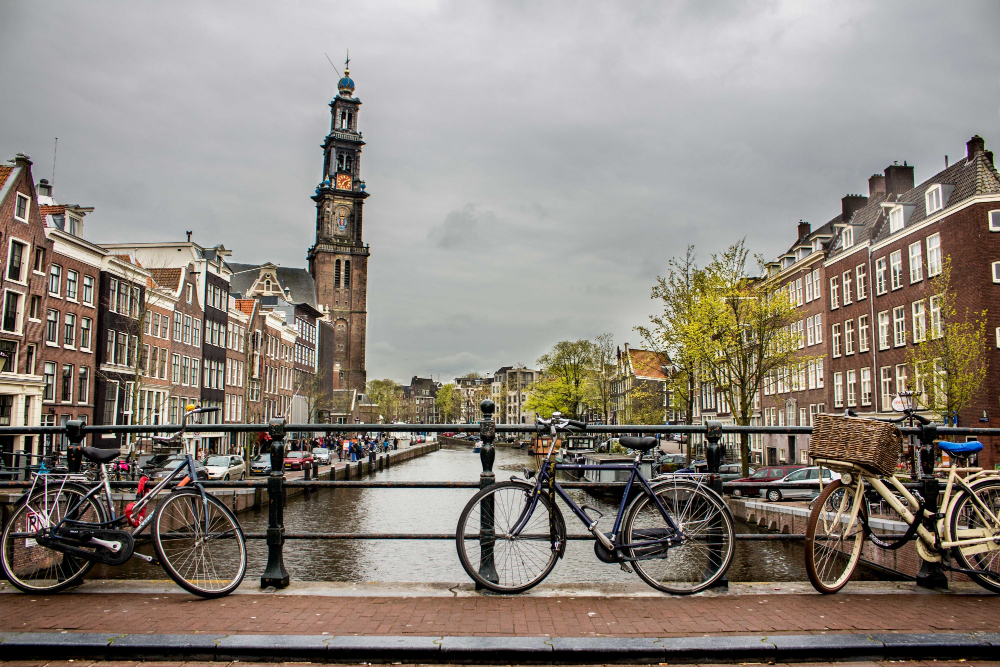
Amsterdam’s reputation has been assembled from a narrow selection of the city’s actual qualities — the coffee shops, the red light district, the permissiveness that has made it the destination of choice for bachelor parties from every country with a budget airline connection. Those things exist, within their categories, but the tourist demographic they produce bears very little relationship to what Amsterdam actually is: one of the most architecturally coherent, culturally serious, and genuinely liveable cities in Europe. The people arriving for the stag weekend and the people arriving for the Rijksmuseum are visiting the same city in the way that Paris Disneyland visitors and Louvre visitors are visiting the same city. Technically true. Practically, entirely different.
The Canals: What the City Actually Is
Amsterdam was built in the 17th century by Dutch merchants running the most successful trading empire in the world. The canal ring — the Grachtengordel, a UNESCO World Heritage Site — was designed as concentric semicircles with plots taxed on canal frontage, which is why the houses are tall, narrow, and have the distinctive gable tops that make the skyline recognisable. The staircases inside are so steep they are practically ladders — narrow plots left no room for conventional stairs — a problem the Dutch solved with a hook above every top-floor window for hoisting furniture, which you will notice if you are staying in a canal house and attempting to move a suitcase to the fourth floor.
Walk the Jordaan neighbourhood — the former working-class district west of the main canal ring, now a tightly packed grid of narrow streets and independent shops and brown cafés (bruine kroegen, the traditional Dutch pub, dark-panelled and sand-floored and smelling of beer and history) — on a Saturday morning when the markets are running. This is the city as it actually lives, and it is considerably more interesting than the area around the Leidseplein, which is the city as it performs for visitors.

The Museums: The Actual Reason to Go
The Rijksmuseum contains the finest collection of Dutch Golden Age painting in the world — Rembrandt’s Night Watch, Vermeer’s The Milkmaid, hundreds of works by painters who produced, in the 17th century, a school of painting so technically accomplished and so specifically attentive to the texture of daily life that art historians are still working out how to fully account for it. The museum is enormous and could absorb two full days. It won’t need to — go straight to the Gallery of Honour, where the masterpieces are concentrated, and spend the time you would have spent anywhere else standing in front of The Night Watch, which is larger than you expect and more extraordinary in person than any reproduction suggests, and which Rembrandt painted in 1642 and which has not required any revision since.
The Van Gogh Museum next door houses the world’s largest Van Gogh collection, with his letters to Theo displayed alongside the paintings they describe — a correspondence between word and image that makes the work feel less like art history and more like knowing someone. Book both in advance. The queues without a reservation turn a good day into an administrative experience.

The Bicycle: The Thing That Makes Everything Else Make Sense
Amsterdam has 800,000 bicycles in a city of 900,000 people. The cycling infrastructure — dedicated lanes, bicycle traffic lights, priority at junctions — is the finest in the world and what makes Amsterdam genuinely different from every other major European capital. Rent a bicycle on day one and use it for everything. The city at cycling pace — the right height to see the canal houses, the gables, the light on water — is the correct speed for experiencing Amsterdam. You will inevitably be in the way of actual Dutch cyclists, who will ring their bells with a directness that is not rude so much as efficient. Move over. They have somewhere to be.

Amsterdam is a serious city that has been saddled with an unserious reputation. Treat it seriously and it will give you one of the finest city breaks in Europe. Arrive for the stag weekend and you will miss the point entirely — which, given what you will be paying for the privilege, seems like a significant waste.
Leave a Reply