
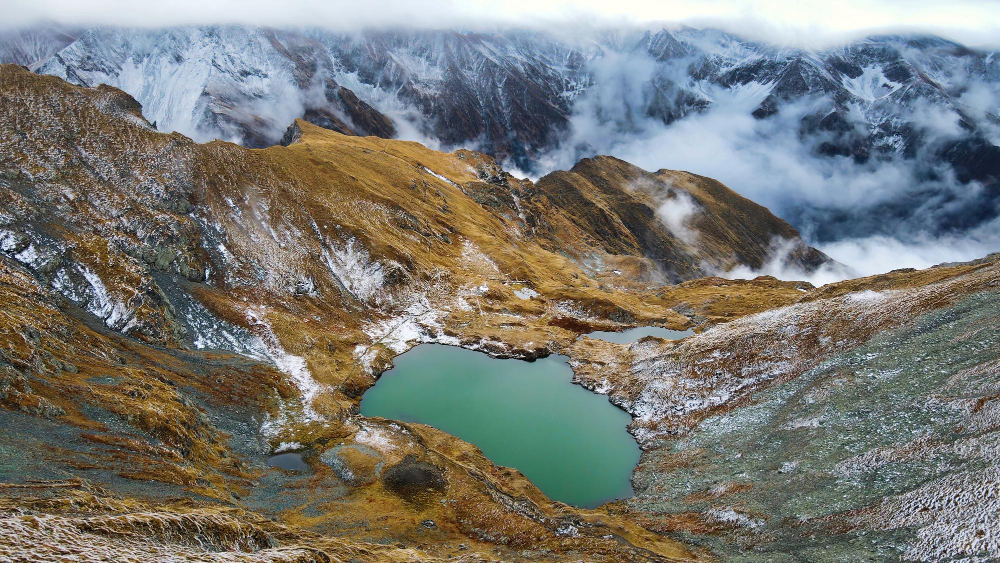
The flight from Delhi to Leh takes one hour and twenty minutes and covers a distance that feels much greater than that. You leave a city of 32 million in the heat of the plains and land in a high-altitude desert at 3,500 metres, ringed by the Himalayas on one side and the Karakoram on the other, where the air is so thin and cold that the first breath outside the aircraft makes you aware of breathing in a way you rarely are. The pilot tells you not to exert yourself for the first twenty-four hours. You ignore this, walk too fast across the tarmac, and spend the first afternoon with a headache the altitude has installed as a reminder that you are a visitor here and the landscape is not obliged to make concessions.
The Monasteries: Ancient, Active, and Entirely Unimpressed by Tourism
Ladakh has over two hundred Buddhist monasteries scattered across its valleys and clifftops, and the highest — Thiksey, Diskit, Lamayuru, Hemis — are among the finest examples of Buddhist architecture in the world. Thiksey rises twelve storeys from its hilltop above the Indus Valley, white and ochre buildings stacked like a small city against the bare mountain, often compared to the Potala Palace in Lhasa — a comparison demonstrating that both were designed by people who understood the right way to honour a landscape is to build something that participates in it.
I arrived at Thiksey at five for the dawn puja — the monks’ morning prayer, filling the hall with horns, drums, and chanting that seems to come from below the floor rather than the seated figures in maroon robes. The butter lamps cast a warmth electric lights would have ruined. The monks did not look up. They were not performing. They were praying — and the distinction was the most important thing in the room.

Pangong Tso: The Lake That Looks Invented
Pangong Tso extends 134 kilometres from India into Tibet at 4,350 metres, and is the most extraordinary body of water I have ever stood beside — not the largest or most remote, but the most visually improbable. The water is a turquoise-blue so saturated it looks less like a natural feature and more like something a production designer created for a film with no brief to be subtle. The bare brown mountains behind are the exact colour brown is before giving up and becoming beige. The sky at this altitude is the exact blue that makes every other sky look washed out. The lake sits between them: simply, flatly, embarrassingly beautiful.
I sat by the lake for two hours, took too many photographs and not enough. The photographs do not explain what it looked like. The memory does not either. This is what certain landscapes do — they exceed what any apparatus of recording is built to capture, and the gap between the experience and any representation of it is the space that keeps pulling people back.

The People: The Part Nobody Warns You About
Ladakhi hospitality is not the effusive, entrepreneurial warmth of the tourist economy but the warmth of people who have been living at altitude in a landscape demanding cooperation for long enough that it has become structural rather than commercial. The butter tea pressed into your hands at every stop, the kitchen opened without question, the direction given with a walk to the turning rather than a pointing at it — not performances. Simply what Ladakhi hospitality looks like when it is not performing for anyone.

What the Altitude Does Over Time
By the fourth day the headache is gone and something else has arrived — a clarity related to the thin air but not entirely explained by it. The landscape enforces an absence of distraction: no urban noise, no constant visual information, just mountains and sky and the sound of wind. The quality of attention this produces is rare in daily life and, once experienced, makes daily life feel slightly louder and slightly smaller than it did before.
Ladakh changes something. Not dramatically, not in a way easy to articulate. But the person who leaves is, in some quiet and specific way, not exactly the same as the one who arrived — which is what the altitude and the silence and the butter tea and the five-in-the-morning puja do, given enough time. It is what the landscape has always done to everyone who stayed long enough to let it.
Ladakh is not a comfortable trip. It will give you a headache on the first day and silence on the fourth and something that takes months to name after you leave. That is not an argument against going. It is the entire argument for it.
Leave a Reply