
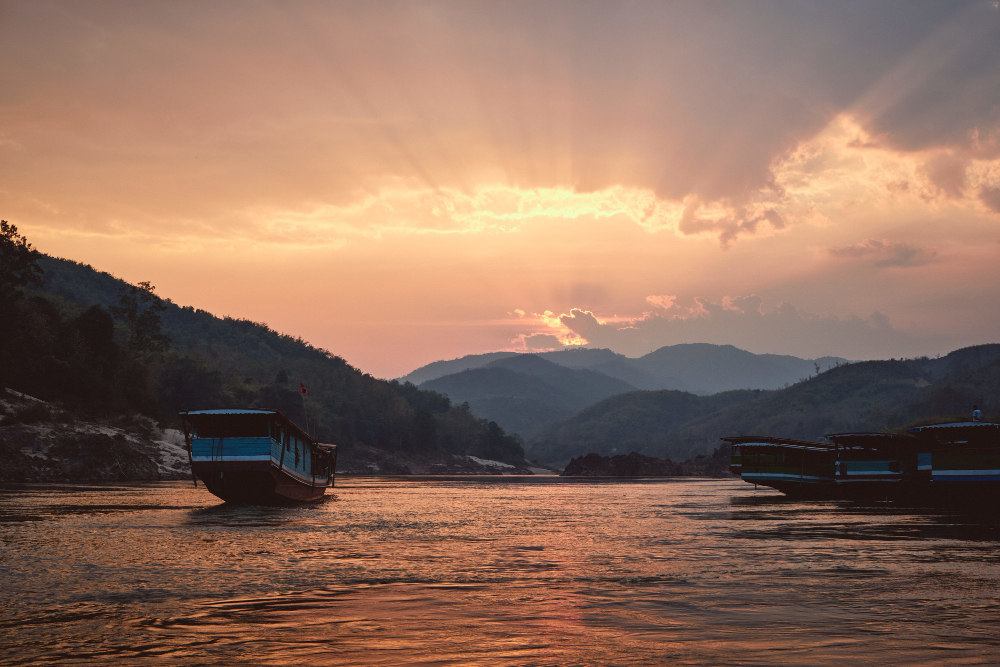
Luang Prabang sits where the Khan River meets the Mekong — the Khan clear and quick and mountain-fed, the Mekong wide and brown and carrying the patience of a river that has crossed four countries before arriving here. Between them, on a narrow peninsula the Lao kings chose for their capital for obvious reasons, a town of extraordinary beauty arranges itself around thirty-three Buddhist temples, a French colonial heritage of tree-lined streets and crumbling yellow plaster, and a food culture of herbs and river fish and glutinous rice that is the most quietly exceptional in Southeast Asia. The town knows it is beautiful. It has known for a long time. This does not make it vain. It makes it serene.
The Monks at Dawn: The Ritual That Defines the Town
At five-thirty in the morning, the monks begin — orange robes vivid against the grey pre-dawn street, feet bare on stone, moving in a silence so complete that the sound of sticky rice placed into bowls is audible from twenty metres. The tak bat alms-giving ceremony has been performed without interruption for centuries. It is not a tourist attraction — it is a religious practice of daily faith, the townspeople participating since childhood, their baskets of glutinous rice prepared before first light, their posture of offering as natural as breathing. Watch from a respectful distance, in silence, without a flash. What you are witnessing is not performed for you. The privilege of witnessing it requires the humility to receive it as such.

The Temples: Thirty-Three Reasons the Town Is a UNESCO Site
Thirty-three Buddhist temples within a small peninsula produces an effect unlike any other town in Southeast Asia — every lane reveals another sweep of low-eaved roof, another gilded stupa, another courtyard of frangipani dropping white flowers onto swept orange earth. Wat Xieng Thong — built in 1560, never abandoned, its multi-tiered roof sweeping almost to the ground — is the temple that most completely captures the town’s aesthetic: an architecture of such careful, confident beauty it has required no embellishment in four and a half centuries.
The interior mosaics — coloured glass in Tree of Life patterns, gold on black lacquer, catching oil lamp light in a way electricity would ruin — are the most beautiful decorative surfaces in Laos. Go in the morning when monks are in residence and incense smoke drifts through the open doors.

The Food: Herbs, River Fish and the Patience of Glutinous Rice
Lao food is the most herb-forward cuisine in Southeast Asia — built on fresh dill, lemongrass, kaffir lime, sawtooth coriander, and herbs arriving at the table in a basket alongside every meal, eaten as accompaniment rather than garnish. The effect is food that tastes clean and complex simultaneously, the herbs cutting through the grilled river fish and the deep, slightly nutty khao niao — glutinous sticky rice eaten by hand, rolled into small balls and used to scoop the other dishes, the intimacy of the hands giving the meal something cutlery removes.
The night market fills every evening with orh lam — Luang Prabang’s stew of eggplant, mushrooms, river fish, and dried buffalo skin simmered with lemongrass and dill in a broth of careful restraint — alongside mango with glutinous rice, the dessert of Southeast Asia, nowhere better than here, where the mangoes grow at the river’s edge in the warm air the Mekong generates around itself.

How Long to Stay and What It Does to You
Most people arrive for two nights and leave wishing they had stayed four. The town has a pace — imposed by the heat, the monks’ schedule, the Mekong itself — that takes twenty-four hours to settle into and another twenty-four to fully appreciate. By the third morning, the walk to the coffee shop at the river’s edge and the hour watching the water and the mountains beyond the far bank starts to feel not like tourism but like simply being somewhere — which is what travel is supposed to produce and most often fails to.
Luang Prabang gives it to you without effort. That, in the end, is what the Mekong teaches everyone who sits beside it long enough.
Luang Prabang is a town that has been beautiful for so long it has forgotten how to be anything else. Spend enough time there and you begin to understand what that feels like from the inside.
Leave a Reply