
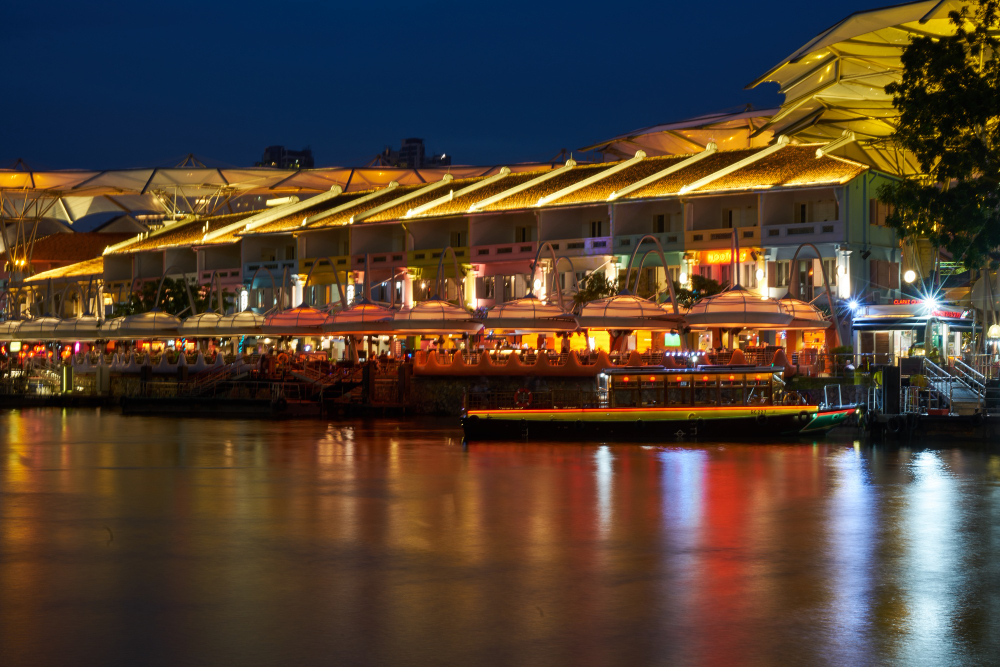
The first time I ate at a Singapore hawker centre, I sat down with a tray of Hainanese chicken rice that had cost five Singapore dollars and thought: this is one of the finest things I have eaten in years. Not “for the price” — not that qualifier we use to lower the bar before clearing it — but simply one of the finest things. The rice was fragrant with chicken fat and pandan and ginger. The chicken poached to a silkiness almost impossible without years of practice. The chilli sauce had a brightness that made the whole plate sing. I was eating it next to a man reading a newspaper who had clearly eaten this same meal hundreds of times and was utterly unimpressed — which told me everything I needed to know about how Singapore relates to its food.
The Hawker Centre: The Most Democratic Institution in Any City
The hawker centre is Singapore’s greatest invention — greater than the airport or the financial district. Dozens of individual stalls each specialising in one or two dishes, cooked by people who have spent decades perfecting a single preparation. Prices are low not because quality is compromised but because overheads are shared, stalls are government-subsidised, and the system was designed in the 1970s to make good food accessible to everyone regardless of income. Urban food policy as civic love — and it produced a food culture so extraordinary that UNESCO gave it Intangible Cultural Heritage status.
What I remember most is not the food alone but the people around it — elderly aunties and uncles who arrived alone and ate alone every day, families with children running between tables, office workers, construction workers, tourists overwhelmed by the choice. All eating seriously at the same plastic tables, paying the same prices. The hawker centre is one of the places where Singapore’s income inequality briefly, genuinely dissolves into the shared act of eating something good.

Chicken Rice, Laksa, and the Argument That Never Ends
Asking a Singaporean which is the best chicken rice stall starts a conversation that ends without consensus. Every Singaporean has a stall they will defend to the death and a reason why all others are inferior — specific, detailed, delivered with the conviction of someone who has been conducting personal research for decades.
Laksa is the other conversation — the Peranakan noodle soup of coconut milk, prawn broth, lemongrass, and chilli so aromatic it produces, on first encounter, the feeling of a flavour combination your palate needed without knowing it. I ate my first bowl in Katong at eight in the morning. The best possible start to any day, and I have been trying to recreate it ever since — which is the relationship most people end up having with Singapore food: chasing the memory of the first bowl, knowing the chase is the whole point.

The Char Kway Teow I Still Think About
There is a char kway teow at a hawker centre in Tiong Bahru that I ate on my third evening and have thought about ever since — not because it was the most technically impressive food I have eaten, but because it was the most honest. Cooked by a man who had been making the same dish at the same stall for thirty years, moving with the economy of someone for whom every gesture has been refined to its simplest form. The wok hei — that smoky caramelisation only very high heat and a well-seasoned wok produce — was present in every bite. It tasted of practice and patience and the pride of someone who decided that one thing done exceptionally is enough.

What Singapore’s Food Culture Actually Teaches
The lesson Singapore offers is that quality and accessibility are not in opposition — that the finest cooking does not require white tablecloths or reservations made three months ahead, and that feeding a city well is a form of governance as important as any other. Singapore figured this out fifty years ago and built the hawker centre as its answer. The answer produced one of the great food cultures in the world, available to anyone with five dollars and a plastic chair. In a world where good food has become increasingly the preserve of the privileged, that is actually rather extraordinary.
Singapore will not let you leave without eating something you will think about for years. Budget accordingly — which, at hawker centre prices, means bring considerably less money than you think and considerably more appetite.
Leave a Reply