
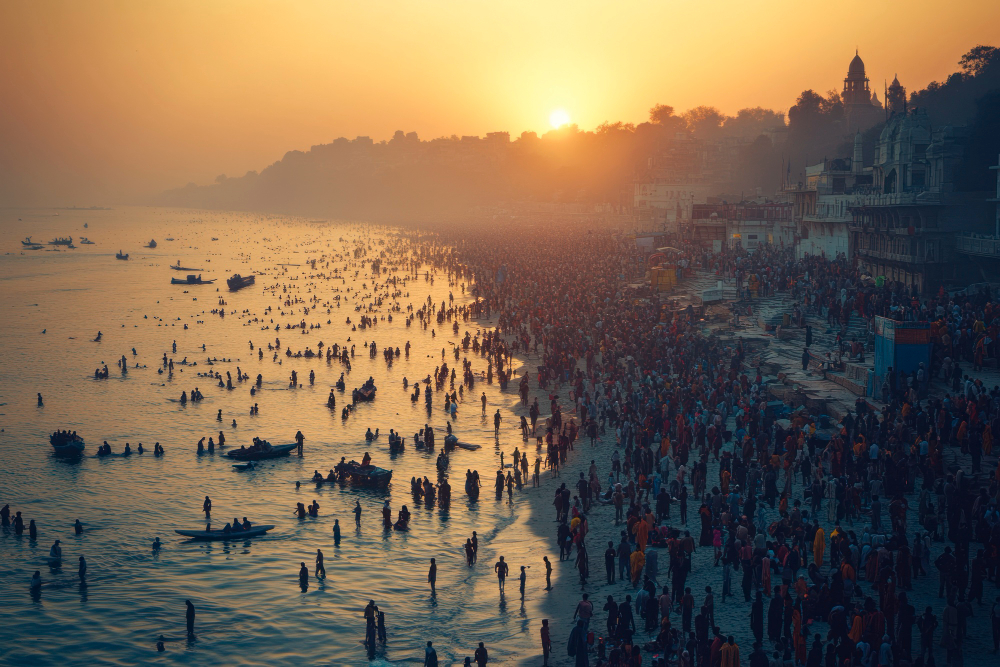
Varanasi is not a comfortable destination — stated plainly and without apology, because visitors who arrive expecting the comfortable version of India leave writing reviews about the smell and the chaos, missing the point so completely it is almost an achievement. Varanasi is one of the oldest continuously inhabited cities on earth — older than Rome, older than Athens — and has been doing what it does for three thousand years without pausing to consider whether visitors find it aesthetically convenient. What it does is conduct, in full public view, the most serious and honest confrontation with death available in any city on earth. If you go with your eyes open to what it actually is, it will give you something no comfortable destination can provide. If you go expecting comfort, Varanasi will decline.
The Ghats: The Place Where India Makes Sense
The ghats — eighty-eight stone steps descending to the Ganga, each with its own character — are where Varanasi lives. At dawn, bathers arrive in the grey pre-light for the daily ritual of purification that the people of Varanasi have performed at this hour for longer than most religions have existed. Boats carry tourists and pilgrims and fishermen in equal measure. Sadhus sit on the steps in states of meditation or conversation that are indistinguishable from the outside. Flower sellers, silk merchants, and boys offering boat rides crowd the top. All of it happening simultaneously, in full view, without apparent awareness that it might overwhelm someone from a city where these things happen separately and in sequence.
The Ganga Aarti at Dashashwamedh Ghat each evening — priests performing the fire ritual with brass lamps swung in elaborate patterns, bells, chanting, incense smoke, thousands watching from steps and boats — is the most spectacular public religious ceremony in India. It is also extremely crowded. Go anyway. Watching from a boat — slightly removed, the whole ceremony visible across the river — is worth every negotiation required to get the boat.

Manikarnika Ghat: The Part Nobody Warns You About
Manikarnika Ghat is the burning ghat — where Varanasi’s cremations have been conducted continuously for thousands of years. The pyres burn around the clock. The business of cremation is conducted with a matter-of-factness reflecting a relationship with death so practised and ancient that the rest of the world’s discomfort is not the ghat’s problem to manage. Hindus believe dying in Varanasi and having ashes scattered in the Ganga grants moksha — liberation from the cycle of rebirth — which is why people come here to die and why the city’s relationship with death is not morbid but genuinely, practically theological.
Do not photograph Manikarnika. This is not a request. It is the one firm rule in a city that has very few. Families of the deceased are present. The grief is real. The moment is sacred. The understanding that not every experience is content is the most important thing Varanasi teaches, and it teaches it at the burning ghat.

How to Be in Varanasi Without Getting It Wrong
Stay at least three nights — the city overwhelming on day one becomes legible on day two and extraordinary on day three. Walk the lanes behind the ghats in the morning when the alleys are quieter and the city is conducting its private life. Hire a boat at dawn — the view of the ghats from the water, in early light, with the entire city arrayed above the steps, is the image that makes Varanasi make sense in a way standing on the steps never quite does.
Accept, as a foundational premise, that Varanasi is not there for you. It has been there for three thousand years for reasons unrelated to tourism, and its extraordinary quality comes entirely from this fact. The visitor who understands this gets something from Varanasi that cannot be packaged, scheduled, or reviewed.

Varanasi is the most honest city in India and one of the most honest in the world. It will not pretend the difficult things are not there. Neither should you. Go with that understanding and it will give you something extraordinary. Go without it and you will have missed the point of the oldest living city on earth.
Leave a Reply