
South Indian food is not North Indian food with a different flag. The global understanding of Indian cuisine — butter chicken, naan, biryani — is predominantly North Indian, leaving Tamil Nadu, Kerala, Karnataka, and Andhra Pradesh largely invisible. South Indian cuisine is built on rice, lentils, coconut, and tamarind, with a spice palette producing heat of a completely different character — brighter, more aromatic, more immediately alive — than the cream-softened warmth of the north. It is one of the oldest, most nutritionally sophisticated, and most deeply pleasurable food cultures on earth. The rest of the world is catching up.
The Dosa: The Breakfast That Requires Overnight Preparation and Rewards Every Hour of It
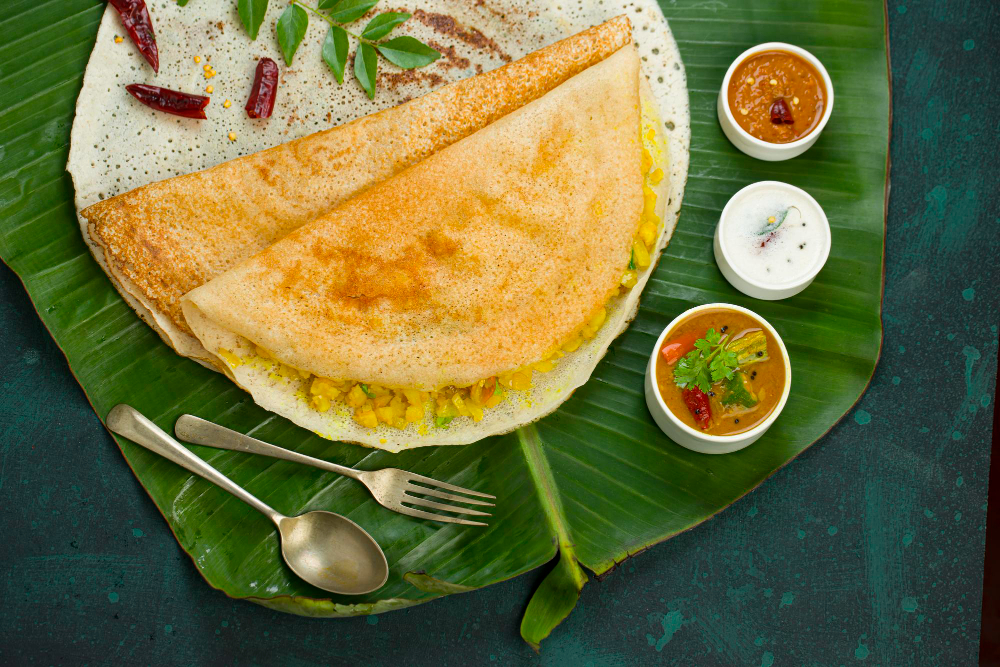
The dosa is made from fermented rice and urad dal batter — soaked, ground, combined, and left overnight until slightly sour and full of air bubbles that make the finished crepe simultaneously thin, crispy, and slightly honeycomb-textured inside. Spread onto a hot griddle and cooked until the edges crisp and the centre remains just soft, it emerges as something delicate and substantial — a crepe the size of a serving platter that shatters at the touch and releases a fragrance of fermented grain and hot iron that is one of the most appetite-inducing smells in any food culture.
The masala dosa — filled with spiced potato, served alongside a bowl of sambar (the tamarind and lentil broth spiked with tomatoes and drumstick and a dozen spices that is the universal accompaniment to almost every South Indian meal) and two or three chutneys, of which the coconut chutney made from freshly grated coconut and green chilli and curry leaf is the essential one — is the version that most people encounter first and that most people eat for every available breakfast for the duration of their time in the south, which is the correct decision.

Rasam: The Soup That Does Everything
Rasam is tamarind water spiced with black pepper, cumin, and dried red chilli — soured to a brightness that makes the palate pay attention, thin enough to drink but complex enough to eat over rice. The third course of the traditional South Indian meal, it clears the head and the sinuses and the lingering heaviness of everything before it. A culinary reset button so effective it has been used medicinally for centuries and remains the South Indian grandmother’s answer to a cold, a hangover, or any condition requiring something restorative. Eating it poured over rice with a papad is understanding why South Indian cooking needs no cream to be profoundly satisfying.

Filter Coffee: The South Indian Non-Negotiable
South Indian filter coffee — hot water dripped through finely ground coffee and chicory, mixed with hot milk, poured from a height between steel tumbler and davara to cool it and create froth — is the cup that starts every South Indian morning and ends every meal. The coffee of Tamil Nadu and Karnataka, grown at altitude in the Western Ghats, is earthy and slightly chocolatey, the chicory adding sweetness without making it confectionery. The steel tumbler is not a compromise. It is the correct vessel for a drink this particular and this good.

Kerala Fish Curry: The Sea on a Plate
Kerala’s fish curry is built on coconut milk, kodampuli (Malabar tamarind, a dried fruit that gives the curry its characteristic sourness and dark colour), curry leaves fried in coconut oil until they release their extraordinary fragrance, and whatever fish was swimming in the backwaters or the Arabian Sea that morning. The flavour is simultaneously rich and light — the coconut milk giving body without heaviness, the kodampuli cutting through with an acidity that makes every bite feel fresh — and the fish, cooked just through so it flakes at the touch of a spoon, absorbs the broth in a way that makes fish cooked any other way feel like it hasn’t been trying. Eat it over red rice. Eat it slowly. Pay attention to everything it is doing.
South Indian food will not compete for your attention. It will simply be extraordinary until you notice — at which point you will wonder how you spent so long eating the northern version and calling it Indian food.
Leave a Reply