
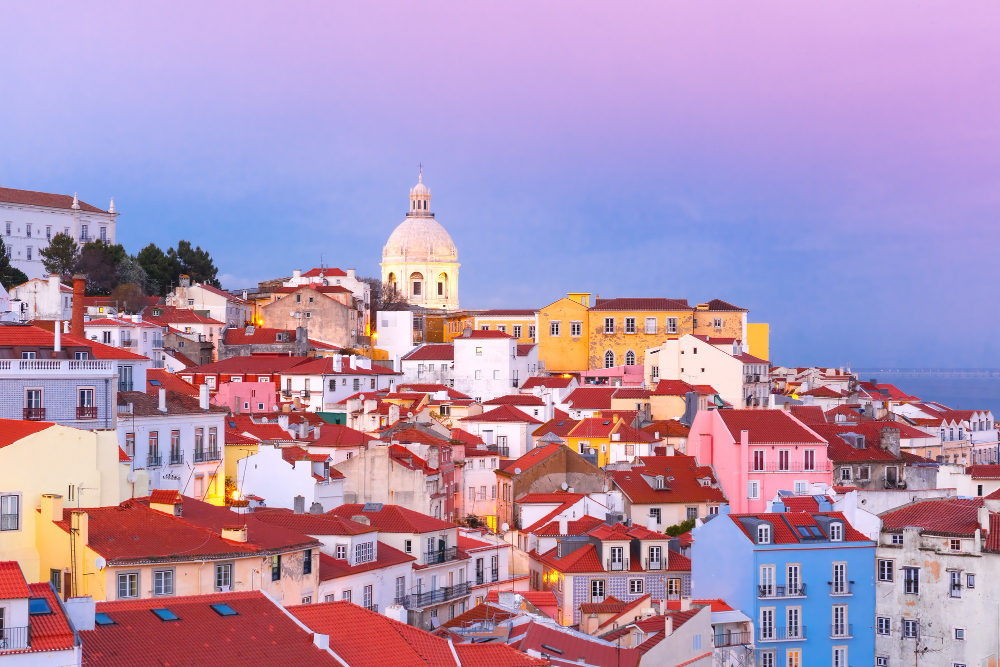
There is a quality of light in Lisbon that photographers talk about the way musicians talk about acoustics — as something structural, built into the place, inseparable from what the city is. It comes from the city’s position at the edge of the Atlantic, where the ocean air keeps the sky clean and the afternoon sun bounces off the white limestone buildings and the glazed azulejo tiles that cover the facades of half the city in patterns of blue and white and ochre and green. The light in Lisbon in the late afternoon, when it hits the Tagus River and the ochre rooftops of the Alfama neighbourhood and the yellow trams climbing the steep streets of the Graça district, is one of the most beautiful things in European urban life. And then there is the food — pastéis de nata eaten warm from the tray at Pastéis de Belém, the salt cod dishes that come in an allegedly infinite number of preparations, the excellent wine from the Alentejo and the Douro that costs a fraction of what equivalent quality costs in France. And the fado, the melancholy Portuguese music that rises from the bars of the Alfama on weekend nights and which, the first time you hear it properly, in a small room where a woman is singing to an audience of twelve people, does something to you that you will not entirely be able to explain afterward. Lisbon is not the most glamorous European capital, nor the grandest, nor the most internationally famous. It is something better than all of those: a city where the quality of daily life is very high and where that quality is available to visitors at a price point that makes the equivalent experience in Paris or London feel like a bad joke.
The Alfama: Lisbon’s Oldest Neighbourhood and Its Most Alive
The Alfama is the oldest continuously inhabited neighbourhood in Lisbon — a Moorish quarter that survived the 1755 earthquake that destroyed most of the city because its position on the hillside, built on bedrock rather than the alluvial mud of the Baixa below, held firm while the flatter city crumbled. Walking through the Alfama is an experience that has no real parallel in other European capitals: the streets are barely wide enough for two people to pass, tiled staircases climb between whitewashed buildings hung with laundry, neighbourhood cats regard you from windowsills with absolute indifference, and the sound of fado — recorded, live, or simply hummed by someone in an upstairs apartment — appears and disappears around corners as you climb. The Miradouro das Portas do Sol and the Miradouro de Santa Luzia are the two viewpoints you should sit at with a coffee and spend time at properly, not just stop and take a photograph: the view over the orange rooftops to the Tagus and the Ponte 25 de Abril bridge beyond is something you want to absorb slowly. The São Jorge Castle, sitting at the top of the Alfama hill, is more about the walk up and the view from the ramparts than the castle itself — the ramparts give you 360-degree views across the whole city and out to the river, and on a clear day you can see the Serra de Sintra mountains to the west. Come to the Alfama on a Saturday morning when the Feira da Ladra flea market spreads across the Campo de Santa Clara — old books, vintage ceramics, antique azulejo tiles, second-hand clothing, and the general wonderful chaos of a market that has been running in some form since the 12th century.

Pastéis de Nata and the Food That Makes Lisbon Worth the Trip Alone
The pastel de nata is a custard tart — a flaky pastry shell filled with a rich egg custard, baked at very high heat until the surface blisters and caramelises in patches of dark amber — and it is, without qualification, one of the great things to eat in the world. The original recipe was developed by monks at the Jerónimos Monastery in Belém in the early 19th century, and the bakery that has been making them using that original recipe since 1837, Pastéis de Belém, is worth the 15-minute tram ride from central Lisbon to eat them fresh from the oven, dusted with cinnamon and powdered sugar, at the marble counter. Every other bakery in Lisbon also makes them, and most of them are excellent, but the specific custard-to-pastry ratio and the degree of caramelisation at Pastéis de Belém is the benchmark. Beyond the pastel de nata, Lisbon’s food scene is built on bacalhau — salt cod, the national obsession, supposedly available in 365 different preparations — grilled sardines eaten at the outdoor tables of the Alfama and Mouraria in summer, piri-piri chicken from the Alentejo-influenced rotisserie restaurants of the Intendente neighbourhood, and the petiscos bars of the Bairro Alto and Mouraria where small dishes of cured ham, sheep’s cheese, lupini beans, and fried anchovies are eaten alongside glasses of cold vinho verde or the slightly cloudy, slightly fizzy Lisbon wine called Ramisco. The food is simple and good and priced for people who live there, which is the most reliable sign of a city whose food culture is genuine rather than performed for visitors.

Belém, Sintra, and the Day Trips That Complete the Picture
Lisbon’s position at the mouth of the Tagus, where the river meets the Atlantic, gave the city its role as the launching point of the Age of Discovery — the 15th and 16th century Portuguese expeditions that mapped the coast of Africa, reached India, and arrived in Brazil — and the monuments built to commemorate that era are concentrated in the riverside district of Belém, 6 kilometres west of the city centre. The Jerónimos Monastery is the masterpiece: a 16th-century UNESCO World Heritage building in the Manueline style — Portugal’s own late Gothic, encrusted with maritime imagery of ropes, anchors, armillary spheres, and coral — built by King Manuel I using the wealth that the India trade produced. The cloisters are among the most beautiful in Europe: two levels of carved stone surrounding a courtyard where the light falls through tracery so intricate it seems impossible that it was cut by hand. The Torre de Belém, a few hundred metres along the riverbank, is the image that appears on every Lisbon postcard — a small fortified tower built on a platform over the Tagus, Manueline in style, watching over the river as it opens into the Atlantic. Sintra is the day trip: a UNESCO-listed hill town 40 minutes by train from Rossio station, with a Royal Palace in the town centre, a Moorish castle on the ridge above, and the extraordinary Pena Palace — a 19th-century Romantic fantasy of towers and battlements painted in ochre and terracotta and burgundy on the highest point of the Sintra hills — that is one of the strangest and most magnificent buildings in Portugal. Go on a weekday. Arrive early. The crowds in Sintra in summer arrive by 10am and the experience is significantly better before them.

Fado: The Music That Belongs Only to Lisbon
Fado is Portuguese music, but it is more specifically Lisbon music — a form of song that emerged from the Alfama and Mouraria neighbourhoods in the early 19th century, carrying the saudade that is the emotional keynote of Portuguese culture: a melancholy longing for things lost or absent or impossibly far away. A fado performance is a singer — the fadista — accompanied by a Portuguese guitarra (a twelve-string pear-shaped guitar with a sound entirely unlike a Spanish guitar) and a viola baixo (a standard six-string guitar). The music is not performed in large venues. The right way to hear fado is in a small casa de fado in the Alfama or Mouraria — an intimate restaurant where dinner is served and then, late in the evening, the singing begins and conversation stops, because in a fado house the protocol is silence when the music is playing, a silence that is not imposed but simply happens, because the music is the kind that commands it. The great fadistas of the 20th century were Amália Rodrigues, whose voice defined the international understanding of fado, and whose museum on Rua de São Bento is the best single hour you can spend understanding what fado is and where it comes from. The living scene is strong — there are young fadistas performing in the Alfama every weekend who are keeping the tradition genuinely alive rather than merely preserving it — and if you hear real fado in a small room in the Alfama, with the wine on the table and the city outside on the hill, you will understand why this music produced a word — saudade — for an emotion that no other language has quite managed to name.
Lisbon asks almost nothing of you and gives back a very great deal. It is a city that rewards walking — all seven hills of it, on foot, with no particular agenda — and a city where the best things cost very little. The pastel de nata from the counter at Pastéis de Belém costs less than two euros. The tram to Belém costs what a tram costs. The fado in the small casa costs what dinner costs. And the light, in the late afternoon, over the Tagus and the red rooftops of the Alfama, costs nothing at all.
Leave a Reply