
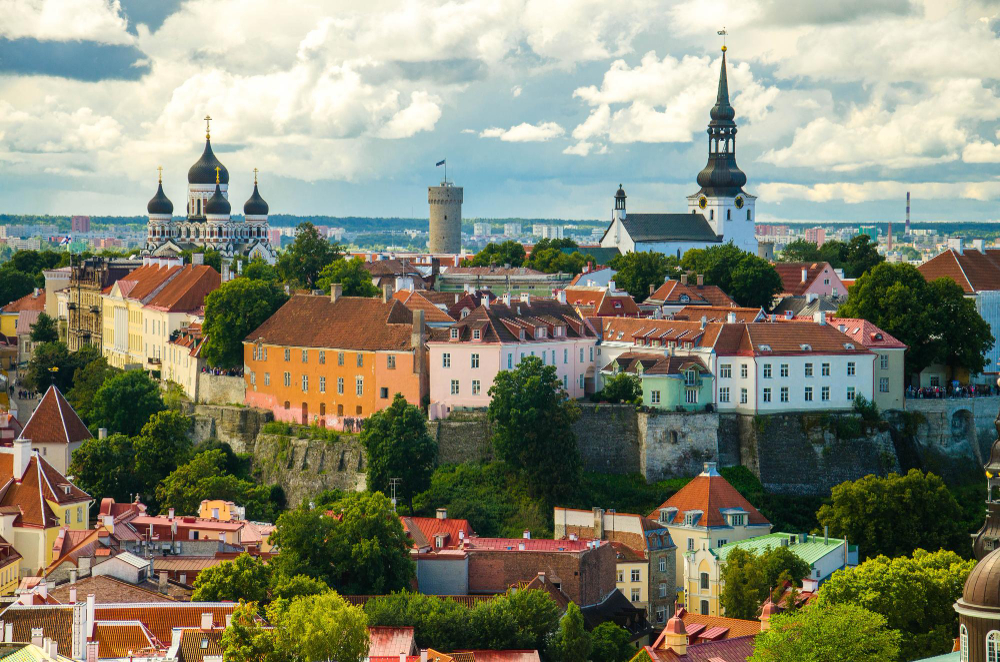
Most medieval cities in Europe exist in fragments — a cathedral here, a castle wall there, a single preserved street surrounded by centuries of rebuilding and modernisation. Tallinn is different. The Old Town of Tallinn, the capital of Estonia on the Baltic Sea, is a UNESCO World Heritage medieval city that is intact in a way that is genuinely difficult to believe until you are standing inside it: the city walls still stand at full height along most of their original circuit, the limestone towers of the 14th and 15th centuries are still the towers of the city’s skyline, the cobblestone streets of the lower town run between merchant houses that the Hanseatic League built in the 13th and 14th centuries and that have been continuously occupied ever since. The reason for this extraordinary preservation is the reason for many of the stranger facts about the Baltic states: Tallinn spent most of the 20th century under Soviet occupation, and the Soviet urban planning that demolished and rebuilt so much of Eastern Europe’s historic fabric was, in Tallinn’s case, largely directed elsewhere. The Old Town was neglected rather than demolished, which is the luckier outcome. Estonia regained independence in 1991, and what emerged from the decades of neglect was a medieval city that needed restoration rather than reconstruction — and which has been carefully, impressively restored in the thirty years since. The result is the most complete medieval urban landscape in northern Europe, sitting at the edge of the Baltic, under a sky that in summer barely gets dark, and in winter goes dark at 3pm and turns the limestone towers and the snow-covered cobblestones into something that looks like a city from a northern fairy tale.

The Upper Town and Lower Town: Two Medieval Cities in One
Tallinn’s Old Town divides into two distinct medieval zones on two levels — the Toompea (Upper Town) on a limestone hill, and the lower town at its base — separated by the ancient city wall and connected by a handful of gates and stairways. The Toompea is where the power always was: the castle that sits at its highest point has been the seat of government since the 13th century and still houses the Estonian Parliament, giving it the distinction of being one of the few medieval castle complexes in Europe that is still actively used for its original political purpose. The Alexander Nevsky Cathedral, built by the Russian imperial administration in 1900 in the onion-domed Orthodox style, sits on the Toompea plateau with a slightly aggressive grandeur that the Estonians have always regarded with ambivalence — it was built by an occupying power on the graves of medieval Estonian nobles, a fact that history has not softened. The viewing platforms of the Toompea — Kohtuotsa and Patkuli — give views over the red-tiled rooftops of the lower town to the Baltic and the modern city beyond that are among the most beautiful urban panoramas in the Baltic region. The lower town is where medieval commerce happened: the Town Hall Square (Raekoja plats), ringed by Gothic and Renaissance merchant houses, with its 15th-century Town Hall still intact; the Dominican Monastery established in 1246; the Guild Houses of the Great Guild and the Brotherhood of Blackheads, where the Hanseatic merchants conducted their trade. All of it connected by cobblestone lanes narrow enough that two people with backpacks require some negotiation to pass each other comfortably.

The City Walls: 2.4 Kilometres of Medieval Fortification, Still Standing
Tallinn’s medieval city walls run for 2.4 kilometres around the perimeter of the Old Town, with 26 of the original 46 towers still standing at or near their original height. This is not a section of wall, not a restored fragment, not a partial survival — it is a continuous circuit of medieval fortification that has been maintained and restored rather than demolished, and walking along the section of wall between the towers that is open to the public gives a physical understanding of medieval urban defence that no museum exhibit can replicate. The towers have names that reflect their original functions and the city’s dark wit: Kiek in de Kök (Low German for Peek into the Kitchen, because the tower was tall enough that soldiers could look into the kitchens of nearby houses), Fat Margaret (a squat, wide cannon tower at the harbour gate whose mass was designed to absorb artillery fire), Tall Hermann (the tower of the Toompea castle that flies the Estonian blue-black-white flag and whose capture or liberation has historically signalled the political fate of the country). The moat that once ran along the outside of the walls is now a park — a long, thin strip of green that traces the old fortification line around the Old Town — and walking it in the evening, looking up at the towers above, is the most peaceful way to understand the scale of what this city was built to defend. Entry to the wall walk and several of the towers is inexpensive; the views from the top of Kiek in de Kök over the Old Town rooftops and down to the park below are worth every step of the climb.

Estonian Food and the Restaurants That Are Making It Worth Talking About
Estonian food is not the reason most people come to Tallinn, but it is increasingly a reason to stay longer than planned. The traditional cuisine is Nordic in character — rye bread, pork, blood sausage, cured fish, fermented dairy, root vegetables — and the best modern Estonian restaurants are doing with these ingredients what the best Nordic restaurants have done with theirs: returning to traditional preparations with serious technique, serious sourcing, and a genuine interest in what Estonian food is rather than what international fine dining says it should be. Noa, on the waterfront, and Leib, in a limestone cellar in the Old Town, are the restaurants most frequently mentioned in this context and both deliver on the reputation: the smoked fish from Estonian waters, the rye bread baked fresh, the game from the Estonian forests, the berries and mushrooms foraged from the same landscapes that Estonian families have been harvesting since before recorded history. The more affordable daily food of Tallinn is found in the Balti jaam market near the train station, where Estonian grandmothers sell homemade kama (a roasted grain flour mixed with sour milk, an ancient Estonian food with no real equivalent elsewhere), smoked fish, hand-knitted woollen goods, and pickled vegetables from their garden plots, and where the prices reflect the fact that this market is not for tourists. The Old Town restaurants are more expensive and more variable; the best approach is to eat lunch in the Old Town (where set lunch menus are often excellent value) and dinner in the Kalamaja or Telliskivi districts, where the city’s young food scene is doing its most interesting work.
White Nights and Dark Winters: Two Completely Different Tallinn Experiences
Tallinn at 59 degrees north latitude is at the same latitude as Oslo, Gothenburg, and the southern tip of Greenland, which means the seasonal extremes of light are significant and entirely shape the experience of being there. In June and early July, the sun barely sets — the sky goes from late evening gold to a deep blue twilight around midnight and lightens again by 3am, and the city takes on a peculiar, suspended quality during those short dark hours, the cobblestones and limestone towers in a half-light that is neither night nor day. The Tallinn summer is genuinely beautiful: warm enough for outdoor cafés, long enough to feel genuinely leisurely, and lit in a way that makes the city’s already-striking architecture look extraordinary. December and January are the opposite: dark by 3.30pm, cold (average -4°C but variable), and the Old Town under snow and lit by Christmas market lanterns becomes something from a northern European fairy tale that photographers travel specifically to capture. The Christmas market in Raekoja plats is one of the oldest and most authentic in the Baltic region — real Estonian crafts, mulled wine, smoked meats — and the city in December, when the tourist season has largely passed, is quiet, affordable, and in possession of a quality of atmosphere that the summer crowds never quite see. Both seasons are worth experiencing. If you can only choose one, summer is easier, lighter, and longer. But winter in Tallinn, in the snow, inside the medieval walls with the lanterns lit, is the more singular experience.
Tallinn gives you something that is genuinely rare in European travel: a medieval city that is actually medieval, not partially reconstructed or contextually depleted by the tourist economy that surrounds it. Walk the walls in the evening when the day visitors have gone back to their cruise ships. Eat rye bread and smoked fish for breakfast. Watch the Baltic light do what it does in late June at 11pm when it should be dark and isn’t. You will understand why Estonia, having spent so much of the 20th century wanting to be left alone to be itself, has become, quietly and without excessive fanfare, one of the most interesting places in Europe to visit.
Leave a Reply