
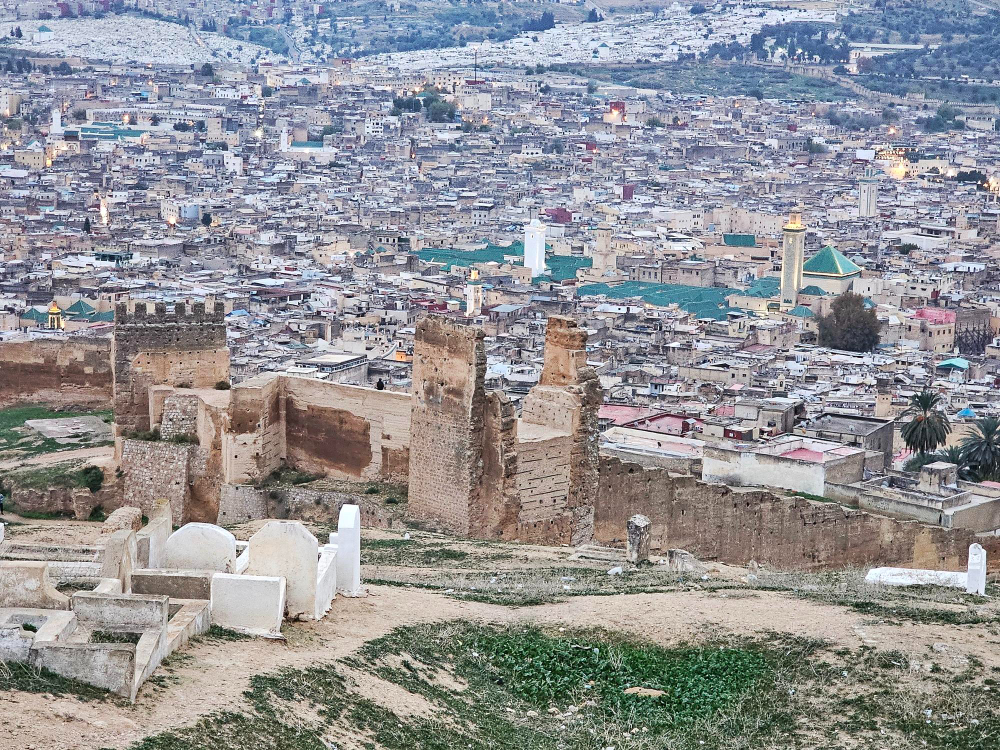
There are cities that feel old. And then there is Fez. Fez el-Bali — the old medina of Fez, founded in the 9th century and continuously inhabited ever since — is the largest car-free urban area in the world: 9,000 lanes and alleyways, some wide enough for two laden donkeys to pass, some barely wide enough for a person to walk through without turning sideways, covering an area of approximately 350 hectares with a density of human activity and architectural history that has no parallel anywhere in the world. The minarets of 800-year-old mosques rise above the roofline. The tanneries at Chouara have been dyeing leather in the same stone vats using the same plant-based dyes since the 11th century. The Bou Inania Madrasa, built in 1355, has tilework and carved plasterwork of a precision and intricacy that contemporary craftsmen spend years apprenticing to be able to replicate. The souks are not tourist markets; they are the working commercial districts of a city where specific trades have occupied specific areas for centuries — the brass workers in one lane, the spice merchants in another, the carpet weavers in a third, the leather workers near the tanneries, the wood carvers adjacent to the mosques that require their work. Fez does not perform its history for visitors. It simply is its history, and the experience of being inside it — genuinely lost, genuinely disoriented, genuinely unsure of whether you are in the 21st century or the 14th — is one of the most singular things that travel can offer.
Getting Lost on Purpose: How to Be in the Medina
The correct approach to Fez el-Bali is not to try to navigate it. Navigation implies a destination, a route, a sense of where you are and where you are going — and the medina will defeat all three of those ambitions within fifteen minutes of entry through any of its gates. The lanes branch without logic visible to the newcomer, double back on themselves, dead-end in private courtyards, and change character so completely from one turn to the next that the mental map you were constructing becomes useless before it is complete. This is not a flaw. It is the feature. The medina was not designed for navigation by strangers; it was designed for the people who live in it and who carry its geography in their bodies from childhood, who can move from the Bab Bou Jeloud gate to the tanneries to the University of al-Qarawiyyin and back without a single conscious decision about direction. For the visitor, the correct approach is to enter, to surrender the need to know exactly where you are, to follow what interests you — the sound of a hammer on brass, the smell of cumin from a spice stall, the sight of a tiled archway opening onto a courtyard — and to trust that any sufficiently persistent walking in any direction will eventually bring you to a landmark you recognise. Hire a guide for the first half-day, not to see specific sights but to gain a basic orientation — the main axes, the locations of the major monuments, the relationship between the tanneries and the medina gate — and then spend the rest of your time in the medina without one, because the guided Fez and the unguided Fez are two different places and the second one is the real one.

The Tanneries, the Madrasas, and the Al-Qarawiyyin
Three things in Fez are essential in a way that goes beyond sightseeing recommendation and into the category of experiences that change your relationship with time. The Chouara tannery is the first: seen from the rooftop terraces of the leather shops that ring it, the tannery is a grid of circular stone vats — some filled with the white lime solution that softens the hides, some with the pigments that colour them: saffron yellow, poppy red, indigo blue, henna brown — worked by men standing knee-deep in the dye solutions, processing leather using techniques unchanged since the medieval period. The smell is powerful and unavoidable. The shops that provide the viewing terraces will offer you sprigs of fresh mint to hold beneath your nose; accept them. The Bou Inania Madrasa is the second: a 14th-century Marinid school built to the height of Islamic decorative art, its lower walls covered in geometric zellige tilework, its middle section in carved stucco calligraphy, its upper section in carved cedarwood so intricate that the wood appears to have been worked with instruments finer than any chisel — and all of it arranged around a central courtyard with a marble fountain and a pool that reflects the carved wooden ceiling above. Non-Muslims cannot enter the great mosques of Fez, but the madrasas give access to the same quality of Islamic architecture in spaces that are otherwise equivalent. The University of al-Qarawiyyin is the third — founded in 859 AD, it is the oldest continuously operating university in the world, predating Oxford by two centuries and Bologna by over two hundred years, and while non-Muslims cannot enter its main spaces, its existence at the heart of the medina — the reason the medina grew, the institution that drew scholars from across the Islamic world for a thousand years — is felt in every library, every madrasa, every intellectual tradition that the city carries.

The Food of Fez: Bastilla, Mechoui, and What the City Actually Eats
Fez is considered the culinary capital of Morocco — a distinction it holds over Marrakech and Casablanca for reasons that are historical as much as gastronomic: the city’s position as the intellectual and cultural centre of Morocco for centuries meant that its ruling class developed a cuisine of considerable refinement, and the Fassi cooking tradition (Fassi refers to the people of Fez) is the most elaborate and most technically sophisticated in Moroccan food culture. Bastilla is the Fassi dish that defines this sophistication: a large pie made from layers of warka pastry (thinner than phyllo, made by dabbing a wet dough ball repeatedly on a hot plate) filled with spiced pigeon or chicken, egg, and toasted almonds, sealed and baked until golden, then dusted with icing sugar and cinnamon. The combination of savoury spiced meat with sweet pastry and almonds is one of those flavour logic decisions that seems improbable until you eat it and realise that it is entirely correct. Mechoui — whole slow-roasted lamb, cooked in a clay oven until the meat falls from the bone and the skin is crackled and fragrant with cumin — is the celebratory dish of Fez, sold by weight from the mechoui stalls near the Bab Bou Jeloud gate, eaten with bread and cumin salt, standing at the stall or on any nearby surface, at a price that reflects the fact that this is a working city selling food to its own residents. The harira — the thick soup of tomato, lentils, chickpeas, and fresh coriander that breaks the Ramadan fast across Morocco but is eaten year-round in Fez — is the city’s daily sustenance, and a bowl of it from a medina stall with a chebakia (honey-fried sesame pastry) on the side costs less than a coffee in any European capital.

Staying in the Medina: The Riads That Change the Experience
The riad — the traditional Moroccan townhouse built around a central courtyard with a fountain, its blank exterior wall giving no indication of the interior — is the correct way to stay in Fez, and staying in the medina rather than in the newer Fez Ville Nouvelle is the decision that determines whether your experience of the city is transformative or merely interesting. The riads of Fez are generally less polished than those of Marrakech — fewer international boutique hotel conversions, more family-run guesthouses that have been receiving travellers for decades without significant renovation — and this rougher quality is, in most cases, a virtue rather than a defect. Waking up in a riad courtyard in the medina, to the sound of the morning call to prayer from the nearby mosque and the smell of msemen (layered Moroccan flatbread) being made in the kitchen below, and walking directly out into the lanes of the medina rather than arriving in a taxi from a hotel across the city, is an entirely different way of being in Fez. Book early, because the good riads fill months in advance. Read the reviews carefully, because the quality varies more than in Marrakech. And specify when you book that you want a room away from the street if noise is a concern, because the medina begins its day significantly earlier than most visitors are accustomed to, and the lane outside your window will be active by 5am.
Fez asks more of you than most cities. It asks you to abandon the navigation instincts that modern travel has trained into you, to accept being lost as a condition rather than a problem, to sit with the disorientation long enough for the city to start making its own kind of sense. When it does — when the pattern of the lanes begins to feel less random, when the sounds and smells start to form a coherent picture, when you find yourself in a courtyard you have stumbled into by accident and it is the most beautiful thing you have seen all day — you will understand why people who come to Fez for three days extend to a week, and why the city stays with you long after the disorientation has faded into memory.
Leave a Reply