
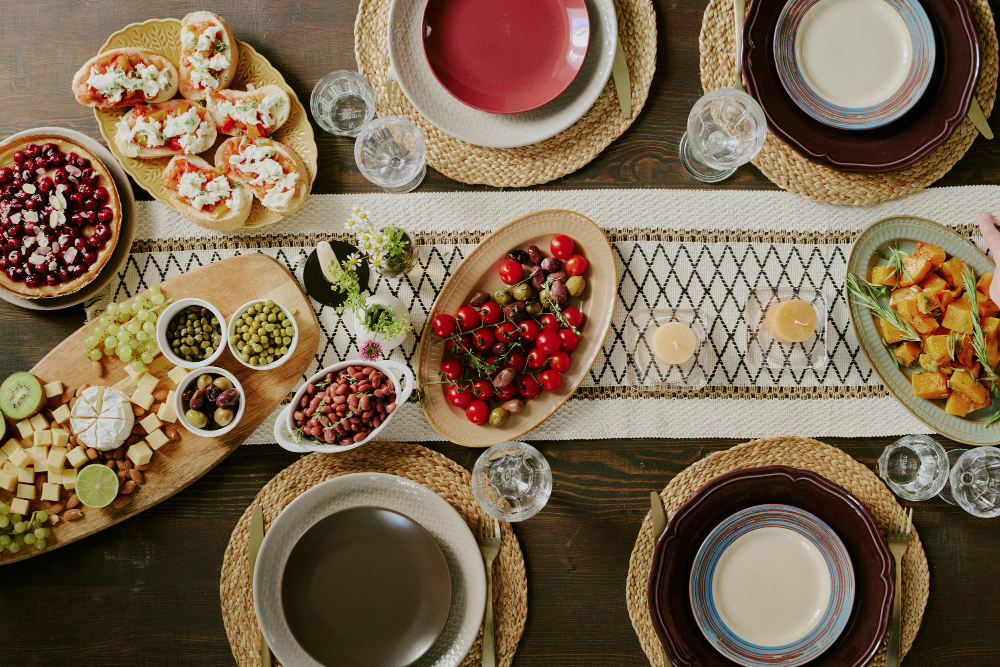
Syria sits at the geographical and historical centre of the Fertile Crescent — the arc of land between the Tigris, Euphrates, and Mediterranean where agriculture began, where the first cities were built, where the oldest continuously inhabited city on earth (Damascus, founded around 10,000 BC) has been feeding its population for longer than any other urban settlement in the world. This history matters to the food, because Syrian cuisine is not simply old; it is the accumulated product of every civilisation that has passed through this crossroads — the Phoenicians, the Romans, the Byzantines, the Umayyads who made Damascus their capital, the Crusaders, the Ottomans — each leaving something in the spice markets, the cooking techniques, the specific combination of ingredients that defines the Syrian table today. Aleppo, in the north of the country, was for centuries one of the most important cities in the Ottoman Empire and a trading hub where the spice routes from Persia and India met the Mediterranean trade, and its food culture — richer, more complex, more spiced than the food of Damascus — reflects that position as a market city at the intersection of empires. Syrian food is the Levantine table at its deepest and most elaborate: the meze that covers the table in twenty small dishes before the main course arrives, the kibbeh in its hundred regional variations, the pomegranate molasses that sharpens every sauce it enters, the Aleppo pepper that warms everything it touches with a gentle, fruity heat that no other chilli in the world quite replicates.

Kibbeh: The Dish That Syria Makes Better Than Anyone
Kibbeh is the national dish of Syria, Lebanon, and arguably the entire Levant, but it is in Syria — and specifically in Aleppo — that it reaches its greatest variety and its greatest refinement. The basic form is simple and ancient: bulgur wheat pounded with minced lamb until the two become a single smooth paste, seasoned with allspice, cinnamon, and black pepper. What is done with that paste is where the regional creativity of Syrian cooking fully expresses itself. Kibbeh nayyeh is the raw version — the paste seasoned, shaped, drizzled with olive oil, and eaten with fresh mint and spring onions, a dish that requires the confidence of knowing exactly where your meat comes from and that is, when the ingredients are right, one of the most purely satisfying things to eat in the Levant. Kibbeh bil sanieh is baked in a tray, layered with a filling of minced lamb, onions, pine nuts, and the seven-spice blend (baharat) that is the aromatic backbone of Syrian cooking, the top and bottom layers of kibbeh sandwiching the filling like a pie, then cut into diamond shapes and served with yoghurt. Kibbeh hamda is the Aleppan version: small torpedo-shaped kibbeh cooked in a sour, lemony broth with Swiss chard and chickpeas, the acidity of the broth cutting through the richness of the meat. Kibbeh in pumpkin, kibbeh fried as small footballs with a crispy outer shell and a spiced meat filling inside, kibbeh cooked in yoghurt sauce — each region, each family, each grandmother has her version, and the catalogue of variations runs to more than fifty documented preparations.

Aleppo Pepper and the Spice Market That Changed How the World Cooks
Aleppo pepper — halaby pepper, named for the city — is a chilli grown in the region around Aleppo that has been traded through the city’s spice markets for centuries and that has, in the last decade, become the darling of professional kitchens from New York to London to Tokyo. The reason is specific: Aleppo pepper has a heat level significantly lower than cayenne or standard chilli flakes, a fruity, slightly oily quality from the high fat content of the pepper itself, a mild sweetness, and a depth of flavour — hints of sun-dried tomato, mild smokiness, a gentle warmth that builds slowly rather than hitting immediately — that makes it function as a flavour ingredient rather than merely a heat source. Syrian cooks use it in everything: rubbed onto lamb before roasting, stirred into the olive oil that tops hummus, added to the filling of börek pastries, used to season the fattet — the dish of toasted bread soaked in broth and yoghurt and topped with chickpeas and a drizzle of red pepper oil — that is the Aleppan breakfast of preference. The great spice market of Aleppo, the Souq al-Attarine (the Perfumers’ Market), was for centuries the place where the spice routes of Asia met the trading networks of the Mediterranean, and the complexity of Syrian seasoning — the baharat blend, the sumac, the dried lemon, the pomegranate molasses, the mahlab (cherry kernel), the mastic — reflects the extraordinary range of ingredients that passed through this market over a thousand years of trade.

The Syrian Table: Pomegranate Molasses, Fattet, and the Art of the Meze
Pomegranate molasses — the thick, intensely sour-sweet syrup made by reducing pomegranate juice until it is almost black and so concentrated that a teaspoon of it transforms whatever it touches — is the flavour signature of Syrian cooking in the way that fish sauce is the signature of Southeast Asian cooking or tamarind is the signature of South Indian. It appears in the muhammara, the Aleppan red pepper and walnut dip that is arguably the greatest meze dish in the Levant: roasted red peppers blended with walnuts, Aleppo pepper, pomegranate molasses, and olive oil into a rough, deeply flavoured paste that is eaten with bread and which, once encountered, tends to make every other dip seem slightly insufficient. It appears in the salad dressing of fattoush, the Syrian bread salad of toasted pita with tomatoes, cucumber, radishes, and fresh herbs. It appears in the marinade for grilled lamb and the sauce for kibbeh hamda. And it appears in the desserts — the knaffe (the shredded wheat pastry soaked in sugar syrup with cheese below), the atayef (the stuffed pancakes fried and dipped in syrup served at Ramadan), the maamoul (the shortbread cookies filled with dates or pistachios or walnuts and pressed with carved wooden moulds) — that represent the Syrian sweet tradition, which is as elaborate and as ancient as the savoury cooking that precedes it at the Syrian table. The Syrian meze is not a preamble to the meal. It is the meal. By the time the main course arrives — the whole roasted lamb, the kibbeh bil sanieh, the grilled kebabs — the table has already been covered for an hour with dishes of hummus and mutabbal and muhammara and fattoush and stuffed vine leaves and pickles and olives and bread, and the eating has been ongoing throughout. The main course is the culmination, not the beginning.
Syrian food is the food of one of the world’s oldest urban civilisations, and it carries that age in the complexity of its flavours and the depth of its hospitality. The Syrian table is not a place where you eat quickly or alone or without conversation — it is an institution of social life, a setting for the kind of generosity that measures itself in how many dishes cover the table and how often the bread is refilled. Find a Syrian restaurant wherever you are. Order the meze. Start with the muhammara. And understand that what you are eating has been refined, in the markets and kitchens of Damascus and Aleppo, for ten thousand years.
Leave a Reply