
Sicily is the largest island in the Mediterranean, and for three thousand years it was the most fought-over piece of land in the sea — occupied in succession by the Greeks, the Carthaginians, the Romans, the Arabs, the Normans, the Spanish Aragonese, the Bourbons, and finally the Italian state — and each of these occupiers left something in the kitchen. The Arabs, who ruled Sicily from 827 to 1072 AD, left the most: saffron, cinnamon, raisins, pine nuts, almonds, pistachios, citrus, sugar cane, and the technique of combining sweet and sour that runs through Sicilian cooking like a thread and that has no real parallel in the food of the Italian mainland. The Greeks left the olive oil and the wine. The Normans left the sweet-and-sour agrodolce tradition that the Arabs had introduced, preserved in the Norman court cuisine that produced some of the most elaborate food in medieval Europe. The Spanish left the tomatoes and peppers of the New World, which arrived in Sicily earlier than elsewhere in the Italian peninsula and were adopted with an enthusiasm that makes tomatoes now feel as ancient as the island itself. The result of all of this accumulated influence is a cuisine that is simultaneously Mediterranean and North African and Arab and Italian and entirely none of those things — a food culture as singular as the island that produced it, and one that rewards serious attention.
Arancini and the Palermo Street Food That Defines the Island
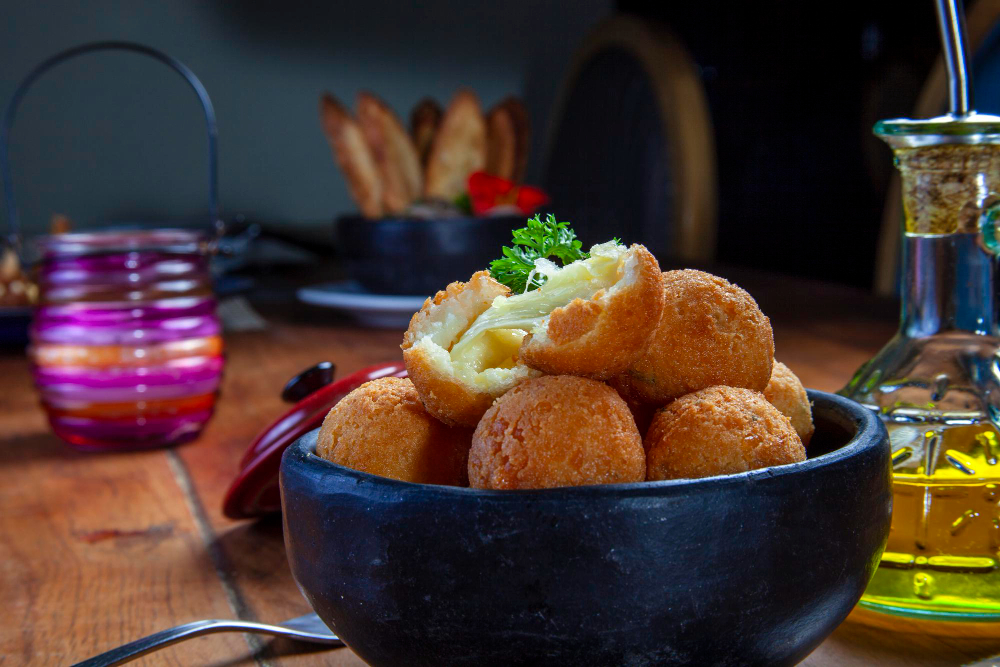
The arancino — fried rice ball, named for its resemblance to a small orange — is the dish that most completely encapsulates Sicilian food culture: it is Arab in origin (the tradition of saffron-scented rice moulded and eaten by hand), Norman in its filling (the slow-cooked ragù of meat that became the standard), and completely, irreducibly Sicilian in its execution, which involves frying a substantial ball of saffron rice around a filling of either ragù and peas (the Palermo standard) or melting mozzarella and ham (the alternative, disputed by ragù purists) in breadcrumbs until the exterior is a perfectly even deep gold and the interior is hot and yielding and rich. They are eaten standing up, from the shops and market stalls of Palermo’s historic centre, wrapped in paper, at any hour from morning to midnight. The Mercato di Ballarò and the Mercato del Capo in Palermo are the correct places to eat arancini in their natural context — alongside the stigghiola (grilled lamb intestines on a skewer, seasoned with onion and parsley, a street food so ancient it predates every occupying power), the pane con la milza (a soft roll filled with sliced veal spleen and lungs, fried in lard and dressed with ricotta or caciocavallo cheese, a sandwich that sounds confrontational and tastes extraordinary), and the sfincione (the Palermitan deep-dish pizza, thick and spongy with tomato, onion, anchovies, and a breadcrumb crust, nothing like Neapolitan pizza and not trying to be). Palermo’s street food tradition is one of the most serious in Italy and one of the most overlooked internationally, because the dishes it centres on — offal, fried things, ancient preparations — are not the dishes that travel easily on restaurant menus. In Palermo, they are what people eat. That is the correct standard.

Pasta alla Norma, Caponata, and the Arab Legacy on the Sicilian Table
Pasta alla Norma is the most famous Sicilian pasta and one of the most perfectly composed dishes in Italian regional cooking: rigatoni (or spaghetti, depending on which Sicilian you ask) with a tomato sauce, fried eggplant, fresh basil, and grated ricotta salata — the aged, salted ricotta of the island that has a sharp, slightly granular quality that finishes the dish with a precision that fresh mozzarella or pecorino cannot replicate. It was invented in Catania, on the eastern coast of Sicily, and named in honour of Vincenzo Bellini’s opera Norma — the Catanese considering the pasta dish as magnificent as the opera, which tells you something about Catanese confidence. The eggplant in pasta alla Norma is the ingredient that reveals the Arab layer of Sicilian cooking: the Arabs introduced eggplant to Sicily in the 9th century and the Sicilian kitchen absorbed it so completely that eggplant now appears in more Sicilian dishes than any vegetable except tomatoes. Caponata is the most elaborate expression of this: a sweet-and-sour agrodolce of fried eggplant with celery, capers, olives, tomatoes, onion, and a combination of wine vinegar and sugar that produces the characteristic Sicilian balance of tart and sweet, cooked together and served at room temperature as an antipasto. The pine nuts and raisins that appear in many versions are the direct Arab inheritance — the combination of dried fruit with vegetables in a savoury dish that appears throughout Sicilian cooking and has no counterpart anywhere in the cooking of the Italian mainland. Pasta con le sarde — pasta with sardines, fennel, saffron, pine nuts, and raisins — is the other canonical expression of this Arab-influenced sweet-savoury tradition, and it is a dish that takes confidence to order if you are encountering it for the first time and extraordinary confidence to leave unfinished once you have tasted it.

Cannoli, Cassata, and the Sicilian Genius for Sweetness
Sicilian pastry is not a department of Italian pastry. It is its own category, operating at a level of baroque elaboration and sweetness intensity that reflects the Arab sugar-craft tradition that arrived in Sicily in the 9th century and has been developing ever since. The cannolo — a fried pastry tube filled with sweetened sheep’s milk ricotta, studded with candied orange peel and chocolate chips — is the most famous Sicilian dessert in the world and the most frequently misrepresented outside Sicily, where the ricotta filling is too often made from cow’s milk and the tube is filled too far in advance, causing the pastry to soften and lose the shattering crispness that is the entire textural point of the thing. In Sicily, in a good pasticceria, the cannolo is filled to order in front of you, and the combination of the shatteringly crisp fried shell with the cold, lightly sweetened, slightly grainy sheep’s milk ricotta is one of the most satisfying contrasts of texture and temperature and flavour in the dessert canon. Cassata siciliana is the baroque excess version: a dome of ricotta cream inside a shell of green marzipan, covered in white royal icing and decorated with candied fruit in a pattern of extraordinary elaboration, originally a convent sweet made by the nuns of Palermo’s convents for Easter and now available year-round in the island’s pasticcerie. Granita — the Sicilian shaved ice, made with real almond milk, real pistachio paste, real coffee, real lemon, real blood orange — is the breakfast food of the Sicilian summer, eaten with a brioche col tuppo (a soft, slightly sweet bun with a topknot) for dipping, at a bar table in the morning before the heat builds. It is one of the great simple pleasures of the Mediterranean.

Pistachio, Almond, and the Ingredient Geography of the Island
Sicily’s ingredient geography is as specific as any in the Mediterranean, and understanding it is understanding why Sicilian food tastes the way it does. The pistachios of Bronte, on the slopes of Etna in eastern Sicily, are the most intensely flavoured pistachios grown anywhere in the world — smaller than Iranian or Californian pistachios, more resinous, more vividly green, with a flavour concentration that makes them the pistachio of preference for any serious Sicilian pastry chef and, increasingly, for serious pastry chefs worldwide. They appear in Sicilian cooking in forms that would seem excessive elsewhere and are exactly right here: pistachio granita, pistachio cannoli filling, pistachio pesto on pasta, pistachio arancini, pistachio semifreddo. The almonds of Avola, in the southeastern corner of the island, are similarly specific: flat, oval, with a sweetness and an oil content that distinguishes Avola almond paste from any other marzipan, and that makes the almond-paste fruits (frutta di martorana) produced by Palermo’s convents — hand-shaped and hand-painted miniature representations of oranges, figs, peaches, pears, and vegetables, made entirely from almond paste — look and taste like the labour of a civilisation that takes its sweets as seriously as its first courses. The capers of Pantelleria, the volcanic island between Sicily and Tunisia, are cured in sea salt rather than brine, which concentrates their flavour to an intensity that the jarred capers of international supermarkets cannot approach, and which makes them the finishing ingredient in caponata and pasta puttanesca and the anchovy-and-caper preparations that appear throughout the island’s cooking. These ingredients are the reason that Sicilian food tastes like Sicilian food and nothing else, and they are, with increasing availability in international markets, worth seeking out wherever you cook.
Sicilian food is the food of an island that has been invaded, occupied, exploited, and transformed more times than any comparable piece of Mediterranean land, and that has responded to each transformation by absorbing what was useful and making it entirely its own. The Arab saffron in the arancini, the Norman ragù in the filling, the Greek olive oil in the caponata dressing, the Spanish tomatoes in the pasta alla Norma — all of it is Sicilian now, has been Sicilian for centuries, belongs to the island as completely as the pistachios of Bronte and the ricotta of the Sicilian sheep. Eat the cannolo filled to order. Order the pasta con le sarde even if the raisins give you pause. Find the granita with the brioche at 8am. The island earned every one of these dishes through three thousand years of extraordinarily eventful history, and they taste exactly like it.
Leave a Reply