
Japan’s tourism infrastructure is so good, and so thoroughly documented, that a visitor arriving for the first time will almost inevitably follow the same route: Tokyo, the Shinkansen to Kyoto, Nara for the deer, Osaka for the food, perhaps Hiroshima and Miyajima. This is an excellent route. It covers some of the most extraordinary urban and cultural experiences available anywhere in the world. But it misses Kyushu — the southernmost of Japan’s four main islands, separated from Honshu by the narrow Kanmon Strait, accessible by Shinkansen in two and a half hours from Osaka — and in missing Kyushu it misses the part of Japan that many people who have travelled the country extensively consider its most interesting and most pleasurable region to spend time in. Kyushu is where ramen was invented, or more precisely where the specific regional styles of ramen that define the dish globally — the rich, pork-bone tonkotsu broth of Fukuoka’s Hakata ramen — were developed. It is where the most dramatic hot spring landscape in Japan is found, in Beppu and Yufu, where the ground steams and bubbles and the entire city smells of sulphur and the bath culture takes forms that Kyoto’s onsen cannot match. It is where Japan’s ceramic tradition has its deepest roots, in the kilns of Arita and Imari and Karatsu, producing the porcelain that made European royalty bankrupt themselves trying to import it in the 17th century. It is warmer, greener, less formal, and in some ways more openly itself than the cities of Honshu — and it is visited by a fraction of the international tourists who spend their Japan trip on the main island.
Fukuoka: The City That Gave the World Ramen and Kept the Best Version
Fukuoka is Kyushu’s largest city and, by most measures, the most liveable city in Japan — consistently ranking at the top of Japanese quality-of-life surveys for its combination of manageable scale, excellent food, proximity to nature, and a warmth of character that distinguishes it from the more formal cities of Honshu. It is also the city that gave the world tonkotsu ramen. The Hakata district of Fukuoka — where the ramen style takes its name — is where tonkotsu broth was developed: pork bones boiled at a rolling boil for hours until the collagen renders out and the broth turns milky white and thick with an unctuousness that no other ramen broth achieves. Hakata ramen is served with thin, straight noodles that cook in seconds in the hot broth, chashu pork belly, a soft-boiled egg, bamboo shoots, nori, and a spoonful of pickled ginger on the side. The noodles are ordered “firm” (kata) or “extra firm” (hakata) in preference, because in a tonkotsu broth this rich the noodle texture is critical — too soft and they disappear into the soup. The yatai — the outdoor food stalls that line the Nakasu riverside in Fukuoka — are the correct place to eat Hakata ramen: small mobile stalls with a canvas awning and eight seats, open from around 6pm until the small hours, serving ramen and gyoza and beer to a crowd of office workers, students, and increasingly tourists who have worked out that the yatai experience is unlike anything available in Tokyo. Fukuoka’s food culture extends well beyond ramen — the Yanagibashi Rengo Market is the city’s best food market, the motsunabe (offal hot pot in a rich soy and garlic broth) is the local winter dish that no visitor should leave without trying, and the hakata mentaiko (spiced pollock roe) that is the city’s most famous export is eaten on everything from rice to pasta to French baguette in the convenience stores and breakfast spots of the city.

Beppu and Yufu: The Hot Spring Landscape That Has No Equal
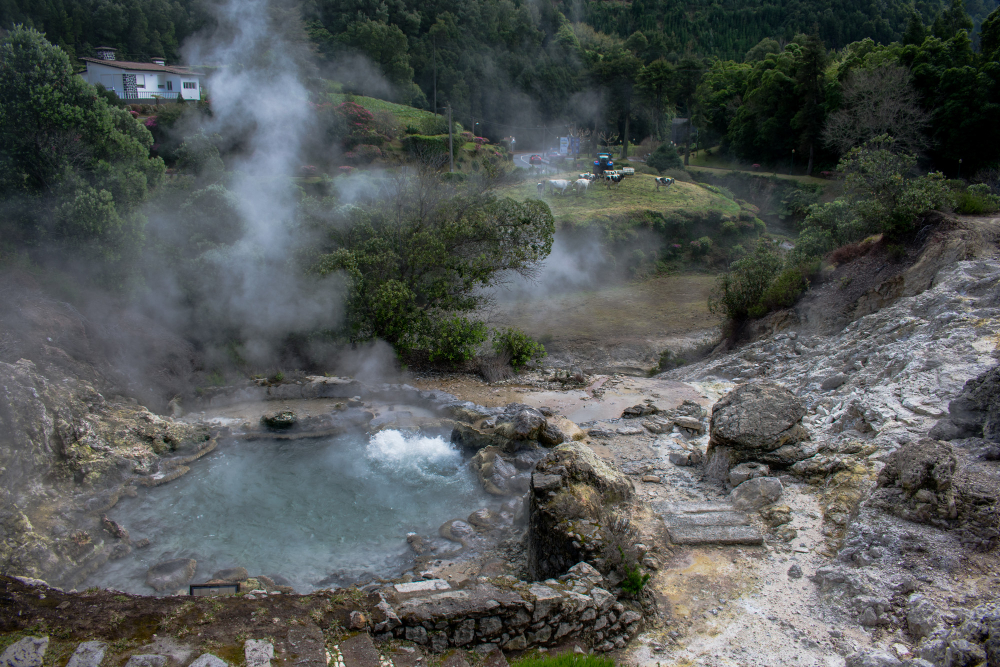
Beppu is the most remarkable hot spring city in Japan and possibly in the world: a medium-sized city of 120,000 people on the eastern coast of Kyushu that sits atop one of the most geothermally active areas on earth, with more than 2,000 individual hot spring sources producing more hot spring water than anywhere in Japan except Yellowstone in terms of volume. The steam that rises from the ground throughout the city — from drains, from the hot spring baths on every corner, from the eight “jigoku” (hells) that are Beppu’s most dramatic attraction — gives the whole city a quality of slightly unreal atmosphere, as if the ground itself is alive and occasionally impatient. The jigoku are the geothermal spectacles of Beppu: Umi Jigoku (Sea Hell), a pool of vivid cobalt blue water at 98°C produced by dissolved minerals; Chi no Ike Jigoku (Blood Pond Hell), a red mud pool of such saturated colour that it looks painted; Tatsumaki Jigoku (Waterspout Hell), a geyser that erupts on a predictable schedule. They are not bathing spots — the water is far too hot — but they are genuinely extraordinary pieces of geology and the combination of all eight in a single afternoon walk produces a sustained state of mild geological disbelief. Yufu, thirty minutes from Beppu by train, is the quieter and more beautiful alternative: a small hot spring town at the foot of the twin peaks of Yufu-dake, with traditional ryokan inns offering private outdoor baths in the forest, a high street of craft shops and tea houses and sweet shops, and the kind of atmosphere that makes the phrase “hidden gem” feel earned rather than promotional.

Nagasaki, Ceramics, and the History That Kyushu Carries
Kyushu carries more international history than any other region of Japan, for the simple reason that it was the part of Japan closest to China and Korea and the part through which, for centuries, all of Japan’s contact with the outside world was filtered. Nagasaki was Japan’s only open port during the two centuries of the Sakoku isolation policy (1635-1853), when all foreign trade and contact was restricted to a small artificial island called Dejima in Nagasaki harbour — and the traces of this history are everywhere in the city: the Dutch-influenced architecture, the Chinatown that has been operating since the 17th century, the temples that reflect the city’s long Chinese trading relationships, the chanpon noodle dish (a Nagasaki invention, Chinese in origin, served in a rich seafood broth that reflects the city’s position as the meeting point of Japanese and Chinese cooking traditions). Nagasaki is also the city where the second atomic bomb fell on 9 August 1945, and the Peace Memorial Museum and the Hypocenter Park are essential visits — sombre, carefully considered, and handled with the same quiet gravity that Hiroshima brings to its own memorial. The ceramic towns of Arita and Imari in the Saga Prefecture of northern Kyushu are the origin point of Japanese porcelain: Chinese potters brought to Japan in the early 17th century discovered the kaolin clay deposits of Arita and began producing the white porcelain with blue underglaze decoration that became Imari ware, exported to Europe by the Dutch East India Company and so desired by European courts that Meissen and Delft were founded specifically to try to replicate it. The kiln towns are still producing, in styles that range from faithful reproductions of Edo-period designs to contemporary work by potters using the ancient clay and the ancient kilns for entirely modern ends.

Getting Around Kyushu: The Practical Case for the Island
Kyushu is well-served by the Shinkansen, which connects Fukuoka (Hakata Station) to Kumamoto, Kagoshima, and points between, making the island entirely manageable as a self-contained trip or as an addition to a Japan itinerary based on Osaka. The JR Kyushu Pass — a regional rail pass available to foreign visitors — covers the Shinkansen within Kyushu and most limited express trains on the island, making the movement between Fukuoka, Beppu, Yufu, Nagasaki, and the ceramic towns of Saga Prefecture efficient and affordable. Fukuoka Airport is one of the most convenient airports in Japan — it is connected to the city centre by metro in six minutes, which puts it in a category of airport accessibility that only a handful of airports in the world share. Spring (March to May) and autumn (October to November) are the best seasons: the cherry blossom in Kyushu arrives a week or two before Tokyo (because it is further south), and the autumn foliage in the mountain areas around Yufu and Aso is among the most beautiful in Japan. The active volcano of Mount Aso, in the centre of Kyushu — the largest active caldera in the world, a landscape of such raw geological scale that standing at its rim on a clear day produces a specific kind of awe that cities cannot replicate — is accessible by bus from Kumamoto and constitutes, in good visibility, one of the most dramatic natural experiences in Japan. Kyushu rewards the visitor who has already done Tokyo and Kyoto and wants to understand what the rest of Japan is — warmer, less formal, geologically dramatic, historically complex, and producing the best ramen in the country from a food stall on a riverside at midnight.
Kyushu is the Japan that rewards the second trip, the longer trip, the trip taken by someone who has been once and wants more of what made the first journey extraordinary. But it is also the Japan that rewards the first trip, if you have the confidence to skip the obvious route and go directly to an island that most of the world’s Japan visitors have not yet discovered. The ramen will be hot. The onsen will be sulphurous and extraordinary. The ceramics in the Arita shops will be more beautiful than you expected. And Fukuoka will turn out to be, as it reliably does for everyone who goes there, one of the best cities in Asia.
Leave a Reply