
The conflation of Catalan cuisine with Spanish cuisine is a category error with political dimensions that Catalans will not let you make twice in their presence, but it is also simply an inaccuracy — a food inaccuracy, on its own terms, entirely apart from the politics. Catalan cooking has a distinct history, a distinct philosophy, a distinct pantry of foundational ingredients, and a distinct set of techniques that differ from Castilian cooking, Andalusian cooking, and Basque cooking in ways that are not superficial. It is a Mediterranean cuisine built on the ancient trade routes of the Crown of Aragon — the medieval Catalan-Aragonese confederation that controlled much of the Mediterranean coastline from Barcelona to Naples to Athens — and it absorbed the cooking traditions of Provence, of the Italian city-states, of North Africa, and of the Arabic culinary tradition that shaped the entire Iberian peninsula, producing something that reflects this Mediterranean breadth rather than the continental Spanish interior. The foundational technique is the sofregit — the slow, patient cooking of onion and tomato in olive oil until they collapse into a dark, intensely sweet paste that forms the base of almost every Catalan stew, braise, and sauce — and the foundational philosophy is one of combining ingredients that other culinary traditions would separate: mar i muntanya (sea and mountain), the pairing of seafood with meat or game that appears throughout Catalan cooking and that produced dishes like chicken with lobster and rabbit with prawns that sound improbable and taste completely correct.
Pa amb Tomàquet: The Dish That Explains Catalan Food Philosophy
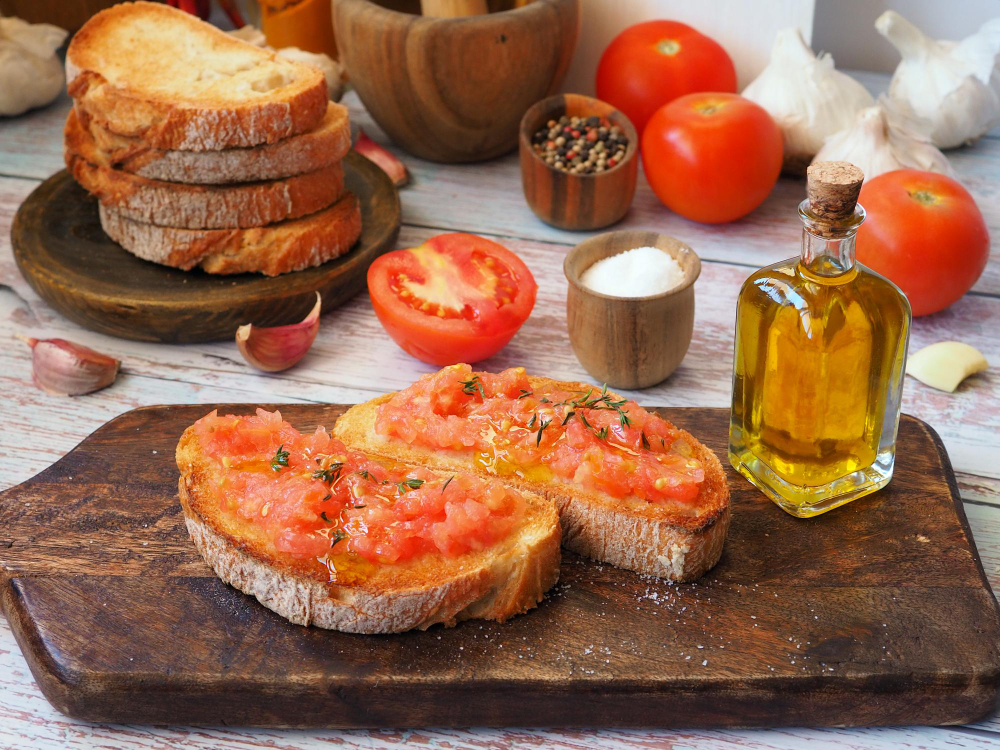
Pa amb tomàquet — bread with tomato — is the most fundamental preparation in Catalan cooking and the most instructive about the philosophy that underlies the entire cuisine. It is, in physical terms, almost nothing: a slice of bread (ideally day-old, firm enough to grate against), a ripe tomato cut in half and rubbed across the surface until the flesh is entirely absorbed and the bread is saturated with tomato juice and pulp, a drizzle of good olive oil, a pinch of coarse salt. The whole operation takes forty-five seconds. The result — and this is the point — is transformative: the bread becomes something it was not before, the tomato disappears into it and becomes something it was not before, and the combination of the two with oil and salt produces a flavour that is not bread and not tomato but is entirely, unmistakably, irreducibly Catalan. Pa amb tomàquet is served as the base for everything in Catalonia: as the foundation under anchovies, under jamón, under cheese, under a slice of botifarra (the Catalan fresh pork sausage). It is the bread at every restaurant table, the snack at every bar, the thing that every Catalan child learns to make before they learn to read. And it is the clearest possible expression of the Catalan culinary philosophy: quality ingredients, minimal intervention, maximum flavour. The tomato must be ripe. The oil must be good. The bread must have substance. Nothing else is required, and nothing else should be added.

Romesco, Picada, and the Sauces That Make Catalan Cooking Distinct
If pa amb tomàquet is the foundational act of Catalan eating, romesco is the foundational sauce — and it is a sauce of such versatility, depth, and specific Catalan character that its absence from international culinary conversation is a minor injustice. Romesco is made from roasted red peppers (traditionally the nyora pepper, a small round dried pepper specific to Catalonia and the Levant), toasted almonds or hazelnuts, roasted garlic, roasted tomatoes, bread fried in olive oil, wine vinegar, and enough olive oil to bring everything together into a thick, textured paste. The result is simultaneously smoky, nutty, slightly sharp from the vinegar, rich from the nuts and oil, and deeply savoury from the roasted vegetables — a sauce that can be eaten as a dip with grilled spring onions (the calçots of the calçotada, the February tradition of grilling large spring onions over vine cuttings and peeling back the charred outer layer to reveal the soft, sweet interior), as a sauce for grilled fish, as a condiment for grilled lamb, or as the base of a fideuà or rice dish. The picada is the other distinctly Catalan sauce technique: a paste of ground almonds, fried bread, garlic, parsley, and sometimes chocolate or liver, added to stews and braises at the end of cooking to thicken, enrich, and add a depth of flavour that is specifically, identifiably Catalan. The picada is why Catalan stews have a body and a complexity that equivalent dishes in other Spanish regional cuisines do not achieve, and understanding it is understanding the technical sophistication that underlies a cuisine that looks simple on the surface.

Fideuà, Escudella, and the Dishes That Define the Catalan Table
Fideuà is the Catalan answer to paella — which is to say, it is a dish that uses toasted short noodles (fideus) instead of rice, cooked in a seafood broth in a wide flat pan until the noodles absorb the broth and stand upright, slightly crispy at the top and soft below, served with alioli (the Catalan garlic emulsion, made without egg in its purest form, simply garlic and olive oil worked by hand into a thick, fierce paste that is both condiment and structural element of Catalan cooking). Fideuà was invented in Gandia, just south of Valencia, by a cook who ran out of rice and substituted noodles, and it has been adopted by Catalonia as the coastal fish dish that is made for Sunday family lunches and festive occasions. Escudella i carn d’olla is the Catalan winter dish that predates almost everything else in the region’s culinary canon: a two-course preparation in which meat, vegetables, and the pilota (a large meatball of pork, egg, bread, and spices) are slow-cooked together in a pot with chickpeas, and the resulting broth is served as the first course with pasta, and the solids as the second. It is a medieval dish — recipes for escudella appear in Catalan manuscripts from the 14th century — and eating it in a traditional Catalan restaurant in winter is the clearest possible connection to a culinary continuity that the Catalan kitchen has maintained across seven centuries.

Crema Catalana, Mel i Mató, and the Catalan Sweet Table
Crema catalana predates crème brûlée by at least two centuries — the earliest Catalan recipes for a cream custard with a burnt sugar crust appear in manuscripts from the 14th century, which is two hundred years before the French version is first documented — and Catalans feel strongly about this priority, in the way that people feel strongly about culinary precedence when the other claimant is France. The Catalan version uses milk rather than cream (producing a lighter, less rich custard), is flavoured with lemon zest and cinnamon rather than vanilla, and is traditionally served on the feast of Sant Josep (19 March) though now available year-round in every Catalan restaurant. The burnt sugar crust, caramelised with a hot iron rather than a blowtorch in the traditional preparation, shatters in exactly the way it should. Mel i mató is the simplest Catalan dessert and one of the most genuinely appealing: fresh mató cheese (an unsalted fresh curd cheese specific to Catalonia, similar to ricotta in texture but lighter, with a mild milky flavour) served with honey — traditionally from the Garraf or Montseny massifs — and nothing else. The combination of the cool, gentle cheese with the fragrant honey is exactly as straightforward and exactly as good as it sounds. The Catalan pastry tradition also includes the carquinyoli — a hard almond biscuit made with whole almonds and flavoured with anise, baked twice in the way of Italian cantuccini, produced in bakeries across Catalonia for dunking in moscatell wine or ratafia (the Catalan herbal liqueur made from green walnuts and dozens of medicinal herbs collected in the mountains).
Catalan food is the food of a culture that has been cooking with intention and with a specific philosophy for at least seven centuries, in a region that sits at the intersection of Mediterranean trade routes and has absorbed the best of what those routes carried — the almonds and the dried peppers, the olive oil and the salted anchovies, the seafood of the Costa Brava and the lamb of the Pyrenean foothills — and done something entirely its own with all of it. Rub the tomato on the bread. Make the alioli without the egg, by hand, until it holds. Eat the fideuà from the pan. And understand that what you are eating is not Spanish food. It is Catalan food, which is a different thing entirely, and has been for longer than Spain has existed as a state.
Leave a Reply