
The Yucatán Peninsula — the flat, jungle-covered limestone shelf that juts into the Gulf of Mexico and the Caribbean between them, containing the Mexican states of Yucatán, Campeche, and Quintana Roo — is geographically, historically, and culinarily distinct from the rest of Mexico in ways that are not superficial. It was the heartland of the Maya civilisation for over two thousand years before Spanish contact, and the Maya did not disappear at conquest: they are still here, still speaking Yucatec Maya alongside Spanish, still farming the milpa (the traditional Mayan intercropping system of corn, beans, and squash), and still cooking the food that their ancestors cooked in the same jungle, with many of the same techniques and many of the same ingredients. Yucatecan food is Mayan food filtered through Spanish colonial influence and Caribbean coastal geography, and it is so distinct from the food of central Mexico and from the Oaxacan tradition that putting them all under the label of Mexican cuisine is like calling Sicilian and Milanese cooking the same because they both happen in Italy. The achiote paste that colours and flavours everything in Yucatán is not used in central Mexico. The sour orange (naranja agria) that provides the acidity in most Yucatecan preparations has no equivalent in Mexican cooking north of the peninsula. The habanero — the fiercest of the Mexican chillies and the one that defines Yucatecan heat — is used here in ways that are completely specific to this regional tradition. And the pib — the underground pit oven that the Maya used to cook food wrapped in banana leaves before the Spanish arrived and that is still the defining technique of the cuisine’s most important dish — is uniquely Yucatecan in its form and its application.
Cochinita Pibil: The Dish the Pit Built
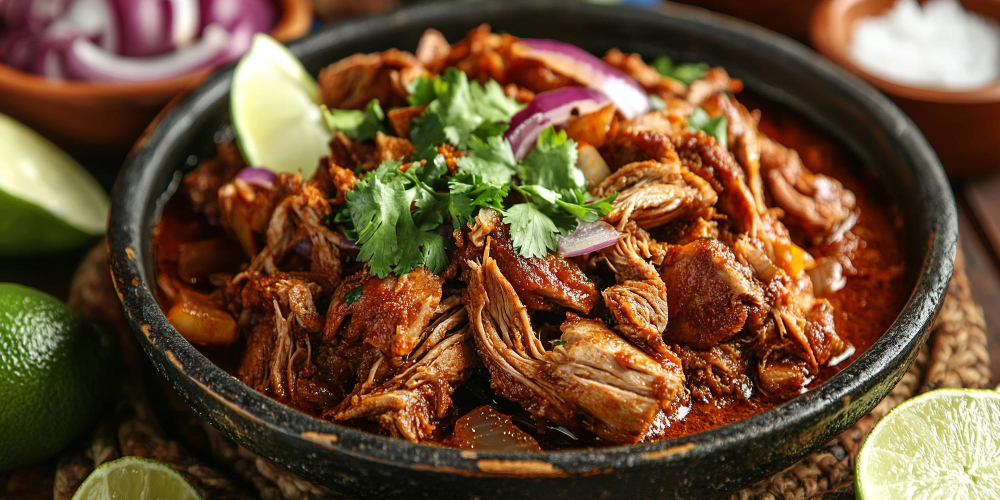
Cochinita pibil is the most famous Yucatecan dish and one of the most important regional dishes in all of Mexico, and its importance is inseparable from the technique that produces it. Cochinita means small pig (or pork, in common usage), and pibil refers to the pib — the underground pit oven of Mayan origin, a hole dug in the earth and lined with stones that are heated by fire until they are searingly hot, into which the food is placed and covered with earth to trap the heat. The pork — marinated for hours in a paste of achiote (the rust-red seed of the annatto tree, used by the Maya as both a food colourant and a body paint for thousands of years before Spanish contact, and providing a flavour that is simultaneously earthy, slightly peppery, and intensely aromatic), sour orange juice, garlic, cumin, black pepper, and oregano — is wrapped in banana leaves, placed in the pit, covered, and left to cook for hours in the trapped heat until the collagen in the pork has completely rendered and the meat pulls apart at a touch into fibrous, intensely flavoured shreds saturated with the achiote marinade. It is served — ideally on a Sunday, when the proper cochinita is made, because in Mérida the cochinita vendors set up before dawn on Sunday and are sold out by mid-morning — on warm tortillas with pickled red onion (cebollas encurtidas en naranja agria, the pink-crimson quick-pickled onion that is the canonical accompaniment and that provides the acidic counterpoint the rich pork requires) and the habanero salsa that arrives alongside everything in Yucatán, its heat a slow burn rather than an immediate one and its fruity, tropical character entirely different from the sharp heat of the jalapeño or the smoke of the chipotle.

Achiote, Sour Orange, and the Flavour Architecture of Yucatán
Achiote paste — the dark red block sold in every market in Yucatán, made from ground annatto seeds, garlic, cumin, oregano, black pepper, cinnamon, and vinegar — is the foundational flavouring of Yucatecan cooking in the way that mole negro paste is the foundational flavouring of Oaxacan cooking, except that achiote is used with a frequency and a versatility that mole cannot match. It goes into the marinade of cochinita pibil and pollo pibil and pescado pibil (the same pit-cooking technique applied to fish wrapped in banana leaves). It is the colouring and flavouring agent in the broth of relleno negro — the complex Yucatecan stew of turkey in a black sauce made from charred and ground chillies, tomatoes, and spices that is the other great ceremonial dish of the cuisine. It appears in the recado rojo — the red spice paste that is the all-purpose Yucatecan marinade — used on everything from grilled chicken to slow-roasted suckling pig at the market stalls of Mérida. The sour orange (naranja agria, a Seville orange relative that grows in the Yucatecan jungle and that is too acidic to eat but perfect for cooking) performs the function that lime and vinegar perform elsewhere in Mexican cooking, providing an acidity that is simultaneously sharper and more aromatic than either, and that appears in the cebollas encurtidas alongside the cochinita, in the dressings for the papadzules (the egg-and-tortilla dish dressed in pumpkin seed sauce and tomato, one of the oldest surviving Mayan preparations), and as the base acid in almost every Yucatecan marinade. The habanero, used fresh and roasted, provides the heat that defines the Yucatecan table — a heat that is among the highest of any Mexican chilli variety but that is tempered by the fruity, almost tropical sweetness of the pepper itself, producing a salsa that is simultaneously the fieriest and the most complex on the Mexican table.

Mérida’s Markets and the Street Food That Defines the City
Mérida is the capital of Yucatán state and the gastronomic centre of the peninsula — a colonial city of yellow and ochre Baroque facades built over and around the Mayan city of T’hó, with a market culture so embedded in daily life that the mercados operate from before dawn and define the social and commercial rhythm of the city more completely than any other institution. The Mercado Lucas de Gálvez is the main market: vast, covered, organised into sections by trade — the produce vendors with the Yucatecan citrus and the habaneros and the chaya (the Mayan green leafy vegetable, similar to spinach in use but more nutritious and more specific to this region), the charcutería with the longaniza de Valladolid (a regional pork sausage that is the Yucatecan breakfast sausage, different in flavour and spicing from any other Mexican chorizo), the prepared food vendors with their pots of frijoles colados (the smooth, strained black bean purée that is the Yucatecan bean preparation, spread on everything from toast to antojitos), and the women making panuchos and salbutes to order. Panuchos are fried tortillas with a pocket of frijoles colados inside, topped with shredded turkey or chicken, pickled red onion, avocado, and tomato — the defining Yucatecan antojito, distinguished from its competitors by the bean-stuffed tortilla that becomes simultaneously crispy and yielding when fried. Salbutes are the version without the bean pocket, simply a puffed, fried tortilla topped with the same ingredients, and they are eaten alongside panuchos at the market stalls and the lunch restaurants of the city centre from morning until the stalls run out, which in the best places is by noon.

Papadzules, Poc Chuc, and the Dishes the Menu Doesn’t Translate
Papadzules are the oldest surviving Mayan dish in regular Yucatecan use: corn tortillas dipped in a sauce of ground pumpkin seeds (the seeds blended with the water in which the chillies and tomatoes were cooked into a green sauce of considerable richness) and then filled with chopped hard-boiled eggs, rolled and served with a tomato sauce on top. The name comes from the Yucatec Maya and means approximately “food for the lords,” and the dish — mild, dense, deeply satisfying in the specific way of pumpkin seed paste — is both genuinely ancient and genuinely delicious in a way that its minimal ingredient list does not immediately suggest. Poc chuc is the simpler modern classic: thin slices of pork marinated in sour orange and salt, grilled over charcoal until slightly charred at the edges, served with a fresh tomato sauce, grilled onions, and the pickled red onions that appear alongside everything in Yucatán. It is the everyday protein dish of the Yucatecan table, the thing that every family grills at home on weekends and that every restaurant serves as a matter of course, and in a good version — the pork marinated long enough, the charcoal hot enough, the sour orange given time to do its work — it is one of the best simple grilled meat dishes in Mexico. Queso relleno — the Dutch Edam cheese (an enduring legacy of the 19th-century Yucatecan trade with the Netherlands, when henequen fibre exports brought Dutch ships to Progreso) hollowed out and stuffed with a filling of spiced ground pork, raisins, olives, and capers, then baked and served in a white sauce and a tomato sauce simultaneously — is the Yucatecan dish that most clearly reveals the collision of Mayan, Spanish, and international trade influences that produced this cuisine, and it is worth ordering at least once for the improbability of its logic and the considerable quality of its execution.
Yucatecan food is the food of a civilisation that did not end at Spanish conquest but adapted, absorbed, and continued — the Mayan milpa still farmed, the pib still dug, the achiote still ground, the habanero still grown in the jungle gardens where it has been grown for millennia. It is the most ancient layer of Mexican cooking, and the most specific, and the least easily encountered outside the peninsula itself. Go to Mérida on a Sunday. Find the cochinita vendor before 9am. Order the panuchos. Ask for the habanero salsa and use it carefully until you understand what careful means in Yucatecan terms. And understand that what you are eating connects directly, without interruption, to the kitchens of the Mayan lords who ate papadzules before the Spanish arrived and long before anyone called this food Mexican.
Leave a Reply