
Bologna has three names in Italian: La Rossa (the Red, for its terracotta porticoes and its communist political history), La Dotta (the Learned, for its university, founded in 1088 and the oldest in the Western world), and La Grassa — the Fat One. La Grassa is the name that matters for anyone who eats seriously, and it is not an insult. In Italian food culture, being called the fat city is the highest possible compliment, a recognition that the cooking of this place and its surrounding region — Emilia-Romagna, the strip of northern Italy between the Po Valley and the Apennines — has achieved a density and quality of food production that no other region in Italy, or arguably in Europe, has matched. Parmigiano-Reggiano comes from here. Prosciutto di Parma comes from here. Mortadella — the original, the Bologna sausage that gave the American bologna its name and bears the same relationship to it that a Stradivarius bears to a ukulele — comes from here. The ragù that the world calls Bolognese sauce was invented here and is nothing like what the world calls Bolognese sauce. The tortellini were, according to the story, invented here in Castelfranco Emilia by an innkeeper inspired by the navel of either Venus or Lucrezia Borgia, depending on which version of the legend you prefer. The balsamic vinegar of Modena — the real thing, aged for twelve years minimum in a series of progressively smaller barrels of different woods — was being made in the Este family cellars before Columbus sailed. This is not a region that is modest about its food, because modesty would be factually inaccurate.

The Ragù: What Bolognese Actually Is
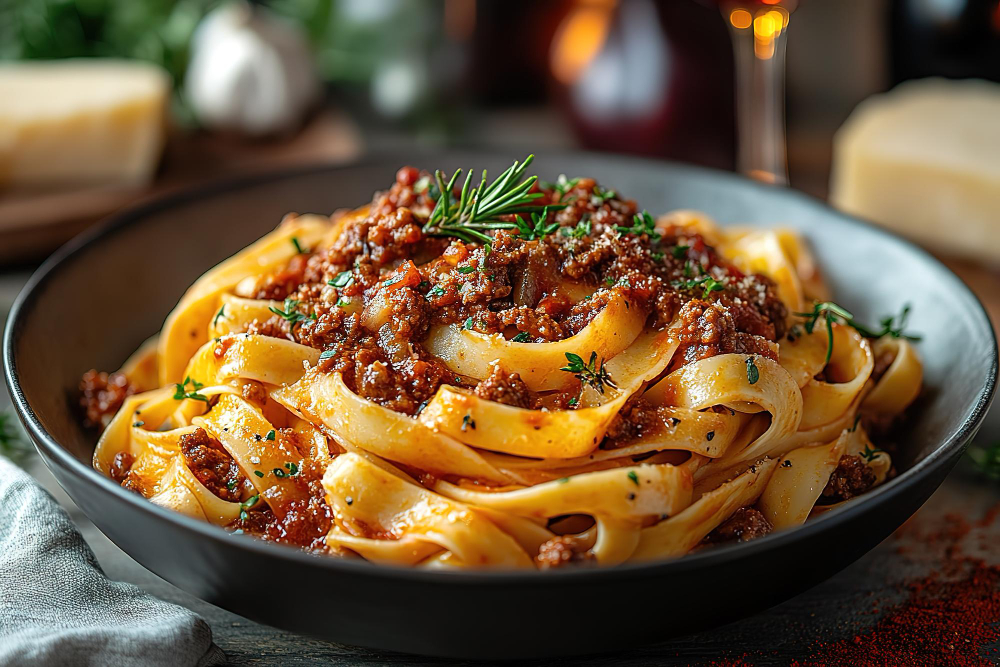
The ragù alla Bolognese that exists in the world outside Bologna — the sauce poured over spaghetti in Italian-American restaurants from New York to Sydney, watery with tinned tomatoes and seasoned with dried oregano — has so little in common with the actual preparation that describing them as the same dish is like describing a photograph of the Sistine Chapel ceiling as equivalent to seeing it in person. The authentic Bolognese ragù is a meat sauce — predominantly beef, with a small amount of pork — cooked with a soffritto of onion, celery, and carrot in butter (not olive oil), with white wine and whole milk and a small amount of tomato (a tablespoon or two of paste, not a tin of tomatoes) added at specific stages of the cooking, and then left to simmer at the lowest possible heat for at minimum three hours and ideally four or five, until the liquid has almost entirely evaporated and the sauce is dark and dense and barely coats the meat rather than the meat floating in the sauce. The result is not red. It is the colour of dark caramel, slightly sweet from the milk, deeply savoury from the hours of cooking, and present in the sauce primarily as concentrated flavour rather than liquid volume. It is served on tagliatelle — the wide, golden egg pasta ribbon of Emilia-Romagna, not spaghetti (the Bolognese delegation to the Italian Academy of Cuisine deposited the official width of authentic tagliatelle — 8mm when cooked, 1/12,270th of the height of the Asinelli Tower — in a gold-leaf register in 1972, which tells you something about how seriously Bologna takes these things) — with Parmigiano-Reggiano grated over the top. The combination of the fat, yielding pasta and the dense, concentrated meat sauce and the salty, crystalline cheese is one of the most deeply satisfying things in Italian cooking, which is a category with a great deal of competition.

Tortellini, Parmigiano, and the Products That Define a Region
Tortellini in brodo — the tiny ring-shaped pasta folded around a filling of pork loin, prosciutto, mortadella, and Parmigiano-Reggiano, served in a clear broth of beef and capon — is the Christmas dish of Emilia-Romagna and the preparation that most clearly reveals the philosophy of Emilian cooking: the richest possible filling inside the most delicate possible pasta wrapper, served in the simplest possible medium (a clear broth) so that nothing competes with the flavour of the filling itself. Making tortellini correctly requires skill that takes years to develop: the pasta must be thin enough to be almost translucent, the filling must be precisely seasoned, the folding must produce a ring that is the right size and the right shape, and the seal must be tight enough to survive the cooking without splitting and releasing the filling into the broth. In the best Bolognese restaurants this skill is visible in the pasta room, where the sfogline (the egg pasta specialists, traditionally female, whose skill is considered a distinct craft) work the dough by hand before rolling it through the machine and cutting and filling the tortellini to order. Parmigiano-Reggiano — the wheel of aged cheese produced from the raw milk of cows fed on the grass of the Po Valley, aged for a minimum of 12 months (24-month and 36-month aging producing progressively more complex and crystalline cheese) — is the flavour backbone of Emilian cooking in the way that olive oil is the backbone of southern Italian cooking. It goes into the tortellini filling, it is grated over the tagliatelle, it is broken into irregular chunks and eaten with a drizzle of aged balsamic vinegar as an antipasto, and in the Parmigiano production dairies of the countryside between Parma and Reggio Emilia, visitors who arrive at the right time in the morning can watch the entire production process — the filling of the vast copper vats, the cutting of the curd, the salting and the pressing and the stamping of the rind — that produces the wheel that will then age for two years in the humidity-controlled warehouses before it is certified and sold.

Prosciutto di Parma, Mortadella, and the Cured Meats of the Emilian Table
Prosciutto di Parma is the most famous product of the Parma area, and the conditions that produce it — the microclimate of the hills south of Parma, where the Apennine winds dry the air and moderate the humidity in a way that no other area of Italy replicates, the specific breed and diet of the pigs, the hand-application of sea salt by the maestro salatore, the minimum 14 months of aging in the designated curing facilities — are as controlled and as specific as any protected agricultural product in Europe. Eating prosciutto di Parma in the area of its production — sliced to order at the salumerie of Parma’s historic centre, served at room temperature on a wooden board with a glass of the local Lambrusco that cuts through the fat with its slight effervescence and tannin — is a different experience from eating it anywhere else, because the product that travels is not quite the same as the product at the source: the fat is creamier, the sweetness more pronounced, the flavour more complex when the ham is fresh-cut and at the temperature of the room in which it was cured rather than the temperature of a refrigerator from which it has not yet fully recovered. Mortadella is the other great Bolognese salume — the large, smooth, pale pink sausage of finely emulsified pork studded with whole white peppercorns and cubes of white fat, produced in Bologna since at least the 14th century and one of the most misunderstood products in Italian food culture, because the American bologna that derives from it has given the original a reputation for cheapness that it does not deserve. Mortadella from a good Bolognese producer — sliced thinly and eaten at room temperature, the fat distributed evenly through the smooth emulsified meat, the peppercorns providing the only interruption — is one of the great Italian salumi, as different from the American derivative as Parmigiano-Reggiano is from the powdered cheese in a shaker.
Modena’s Balsamic Vinegar and Why the Cheap Version Is a Different Product
Modena is famous for two things that appear to have nothing to do with each other: Ferrari (the car manufacturer was founded here in 1929 and the factory and museum are in Maranello, 17 kilometres from the city centre) and balsamic vinegar. The balsamic vinegar connection is the more important one for food purposes, and the distinction between the real product — Aceto Balsamico Tradizionale di Modena DOP, aged for a minimum of 12 years and more commonly 25 years — and the cheap industrial product sold in most supermarkets under the name balsamic vinegar is so large that they should not share a name. Traditional balsamic vinegar of Modena is made from cooked grape must (trebbiano and lambrusco grapes, pressed and cooked until concentrated) and then aged in a progressive series of barrels — a battery of five to seven barrels of decreasing size, made from different woods (oak, chestnut, cherry, mulberry, juniper) — for a minimum of 12 years, during which the vinegar is moved from barrel to barrel as it evaporates and concentrates, each wood contributing something to the flavour, the whole process reducing the volume to perhaps 10% of what was originally produced. The result — thick, dark, slightly sweet, intensely complex, with the vinegar’s acidity balanced by twelve or twenty-five years of sugar concentration — is used in drops rather than tablespoons, drizzled over Parmigiano-Reggiano, over fresh strawberries, over a slice of prosciutto, over a piece of aged hard cheese, over grilled meat — anywhere that a concentrated, complex sweet-sour note will transform what it touches. A 100ml bottle of genuine 25-year Tradizionale costs between €80 and €150 and is worth it. The €3 bottle in the supermarket is a different product entirely and should be used accordingly.
Emilia-Romagna is not the most celebrated food region in Italy internationally — that distinction still goes to Tuscany, whose cuisine has been marketed with more skill and to more receptive international audiences. But among Italian chefs and food professionals, the conversation about which region of Italy cooks best almost always ends with Emilia-Romagna. The ingredients are better — Parmigiano-Reggiano and prosciutto di Parma and traditional balsamic vinegar are the results of protected production traditions that cannot be replicated elsewhere. The pasta is made with more eggs and more skill than anywhere else in Italy. The ragù has been cooked correctly for long enough that the correct version is still the default rather than the exception. La Grassa is the name, and it is not the city apologising for anything. It is the city stating a fact that the rest of Italy’s food culture acknowledges every time it tries, and usually fails, to compete.
Leave a Reply