
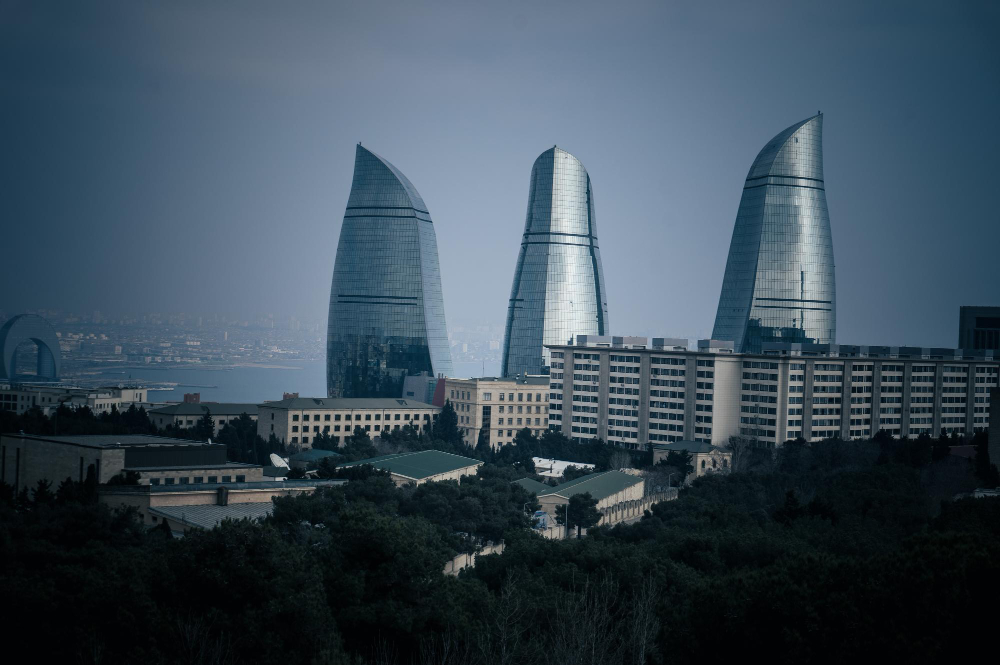
Baku has been built with oil money twice. The first time was in the late 19th century, when the Nobel brothers and the Rothschilds and the Azerbaijani oil barons of the first global petroleum boom invested their extraordinary profits in a city of mansions and civic buildings along the Caspian waterfront — a Belle Époque capital of considerable architectural ambition that produced the oil baron mansions of the Upper City and the Italianate buildings of the old commercial district and a quality of urban fabric that survived the Soviet period intact in a way that is genuinely surprising. The second time was after independence in 1991, when the second oil boom financed the Flame Towers (three glass-clad towers in the shape of flames, visible from most of the city, their LED facades displaying fire effects at night and the Azerbaijani flag on national holidays) and the carpet museum in the shape of a rolled carpet and the Heydar Aliyev Centre (the Zaha Hadid building whose continuously curved white surfaces have been photographed so extensively that it has become the defining image of contemporary Baku) and the regeneration of the Caspian waterfront into a Venetian-style promenade that is one of the most pleasant places to walk in the South Caucasus. Between these two oil-money building campaigns is the İçərişəhər — the Inner City, the walled medieval city of Baku that is a UNESCO World Heritage Site and the oldest part of a settlement that has been occupied since the Palaeolithic period. The combination of medieval walled city, Belle Époque oil baron architecture, Soviet-era urbanism, and Zaha Hadid-era spectacle makes Baku the most architecturally layered city in the post-Soviet space — a city that looks like nowhere else and that most European travellers have not yet encountered.
İçərişəhər: The Walled Medieval City at the Heart of Everything
The İçərişəhər — the Inner City of Baku, enclosed within its medieval walls on the Caspian headland — is one of the most completely preserved medieval urban environments in the South Caucasus and Central Asia, a UNESCO World Heritage Site of narrow cobblestone lanes, caravanserais, mosques, baths, and residential buildings that have been continuously inhabited since the 12th century. The Maiden Tower (Qız Qalası) — the cylindrical stone tower of uncertain origin and unknown function that stands at the southern edge of the Inner City, its purpose debated by historians for centuries (watchtower? Zoroastrian fire temple? defensive fortification? astronomical observatory?) and never conclusively established — is the most recognisable building in Baku and the symbol of the city, its silhouette on every postcard and its interior containing a thoughtful museum of the tower’s history and the theories that have accumulated around it. The Palace of the Shirvanshahs — the 15th-century palace complex of the rulers of the Shirvan kingdom, a collection of buildings around a courtyard that includes the palace, the Shah’s mosque, the mausoleum, and the bath house — is the most important medieval monument in Azerbaijan and the building that most clearly communicates the sophistication of the pre-Russian Azerbaijani cultural tradition. Walking the lanes of the İçərişəhər in the morning — the cobblestone streets barely wide enough for two people to pass, the carved stone facades of the caravanserais and the residential buildings, the cats that have been considered the Inner City’s unofficial residents since before anyone thought to count them — is the experience that gives Baku its grounding in antiquity and that puts the Flame Towers in context: a city that has been here for a thousand years and is still here, behind the walls, doing what it has always done.

The Heydar Aliyev Centre, the Oil Baron Mansions, and the Architectural Timeline
The Heydar Aliyev Centre is the building that put Baku on the international architectural map when it opened in 2012, and it deserves both the attention and the superlatives: designed by Zaha Hadid Architects, built over five years at a reported cost of $250 million, its exterior is a single continuous white surface that folds and curves across the building’s full footprint without a straight line or a right angle, the surface seeming to flow from ground to roof in one uninterrupted movement. The interior continues this language with equal ambition — the grand atrium of flowing white ramps and the gallery spaces that spiral around the central void — and the building functions as a cultural centre housing museums, galleries, exhibition spaces, and conference facilities in addition to being a work of architecture that is visited primarily for itself. Admission is modest, the permanent collection includes significant works from the Soviet and post-Soviet period, and the building in the afternoon light — the white surfaces picking up the warm Caspian haze and glowing slightly — is the thing that every photograph of Baku has been trying to convey since 2012. The oil baron mansions of the Upper City are the other architectural layer that Baku uniquely offers: the Belle Époque residential district built between 1870 and 1920 by the Azerbaijani, Armenian, and European oil magnates who made fortunes in the first global oil boom, their mansions in a range of European revival styles (French neo-Gothic, Italian Renaissance, Moorish Revival, Beaux-Arts) that make the Upper City feel simultaneously like Paris and Tbilisi and nothing like either. The Istiqlaliyyat Street (the former Nikolayevskaya) and the surrounding blocks are the best-preserved section of this district, and the quality of the stone carving and the ironwork and the general ambition of the buildings is consistently higher than the city’s current international reputation would lead a visitor to expect.

The Food, the Tea, and What to Eat in Baku
Baku’s restaurant scene is concentrated in the Inner City and the surrounding streets of the old commercial district, and the best Azerbaijani food in the city is found at the traditional restaurants that have been serving the national cuisine to a population that takes its food seriously rather than the tourist-facing establishments near the Maiden Tower. Plov — the saffron rice dish that is the centrepiece of the Azerbaijani feast table — is the dish to order, and ordering it in Baku with the kazmag crust and the lamb and the dried fruit garnish is the most complete single-dish expression of what the Azerbaijani kitchen has been doing for centuries. The Shirvanshah Restaurant in the Inner City, the Dolma Restaurant in the Upper City, and the traditional tea houses (çayxana) of the old commercial district where tea is served in the armudu glass with jam and rock sugar and the afternoon light comes through the wooden latticework screens — these are the correct addresses for the Baku food experience. The Taza Bazar (the main fresh produce market of the city) is the place to understand what the Azerbaijani kitchen works with: the pomegranates from the Goychay region (the finest pomegranates in the Caucasus, their season from October to December producing fruit of extraordinary size and juice content), the dried fruits and nuts from the mountain regions, the fresh herbs in their abundant quantities, the saffron sold in small packets at prices that reflect a country where it is grown rather than imported. The Caspian caviar — Black caviar from the Beluga, Ossetra, and Sevruga sturgeon — is still available in Baku despite the severe depletion of the Caspian sturgeon population, at prices that reflect its rarity and under regulations that are more strictly enforced than they were a decade ago. It is expensive. It is extraordinary. It is one of those things that cannot be recommended without also noting that the reason for its rarity is the commercial overfishing that the current regulations are attempting to reverse.

Gobustan, the Mud Volcanoes, and the Geology That Explains Everything
The reason Baku has oil — and the reason it has been inhabited since the Palaeolithic — is the geology of the Abşeron Peninsula on which it sits: a unique convergence of tectonic forces that has pushed petroleum to the surface in the form of natural oil seeps and mud volcanoes and the eternal flames of burning natural gas that gave Azerbaijan its ancient name “Land of Fire” and that attracted Zoroastrian fire-worshippers to build temples above the burning ground. Yanar Dag (Burning Mountain), 25 kilometres north of Baku, is the most accessible of these eternal flames: a hillside that has been burning continuously since at least the 13th century (Marco Polo mentioned it), the natural gas seeping from the ground and burning at the surface in a low, orange flame that runs along the hillside without consuming it. The Ateshgah fire temple, 30 kilometres from Baku, is the 18th-century Zoroastrian and Hindu temple complex built above a natural gas vent that burned continuously until 1969 (when industrial gas extraction reduced the surface pressure), now a UNESCO monument with an eternal flame relit from the city gas supply. Gobustan National Park, 60 kilometres southwest of Baku, contains the most significant collection of prehistoric rock art in Azerbaijan — approximately 6,000 carvings of animals, humans, boats, and astronomical symbols, some dating back 40,000 years — alongside one of the world’s largest concentrations of mud volcanoes: low, grey, bubbling mounds of cold mud that erupt periodically from the same geological forces that produce the oil that built the city above them. The combination of prehistoric rock art and mud volcanoes and eternal flames in a single day trip from Baku is the most compressed geology-meets-history-meets-landscape experience available in the South Caucasus, and it is worth every kilometre of the drive.
Baku is the city that most rewards the visitor who arrives without strong expectations and lets the city’s specific character — the layered architecture, the medieval walls, the Caspian waterfront, the Zoroastrian fire temples, the extraordinary food — accumulate into an understanding that no single aspect conveys on its own. It is not Rome or Paris or Istanbul. It is Baku, which is its own thing entirely, and the thing it is is significantly more interesting than the travel media’s current silence on the subject suggests. Fly in. Walk the Inner City. Eat the plov. Watch the Flame Towers at night from the Caspian boulevard. Drive to Gobustan and watch the mud volcanoes bubble in the geological silence of the Abşeron Peninsula. Come back to the tea house in the old city for the armudu of black tea and the jam and the conversation that the Azerbaijani tea tradition exists to produce. The city will be there when you arrive, as it has been for a thousand years, and it will not be what you expected, which is the most reliable indication that it is worth the journey.
Leave a Reply