
Writing a travel blog about Kyiv in the current circumstances requires an honest acknowledgement of what the current circumstances are: Ukraine has been under full-scale Russian military invasion since February 2022, and Kyiv, while not under direct military assault for most of the period since the initial repulsion of Russian forces from the capital in the spring of 2022, has experienced missile and drone strikes, air raid alerts, power outages, and the general conditions of a country at war. Travel to Kyiv during the conflict requires assessment of the current situation at the time of travel, a level of risk tolerance that is individual and cannot be prescribed by a travel blog, and registration with your country’s embassy. This blog is written for the future visitor — for the person who will go when the circumstances allow, who wants to understand what Kyiv is before that day comes, and who recognises that a city of 3 million people that has been defending itself with the resolution that Kyiv has demonstrated since 2022 deserves to be understood rather than merely pitied. Kyiv is one of the oldest cities in Eastern Europe — founded in the 5th century AD, the capital of the Kievan Rus state that was the origin of both Russian and Ukrainian civilisations, a city of 11th-century Byzantine monasteries and Soviet-era boulevards and Art Nouveau architecture and a food and culture scene that was, before 2022, one of the most exciting in Eastern Europe. It will be that again. Understanding what it is makes the return, when it comes, more meaningful than arriving uninformed.
The Pechersk Lavra and the Ancient Layer of Kyiv
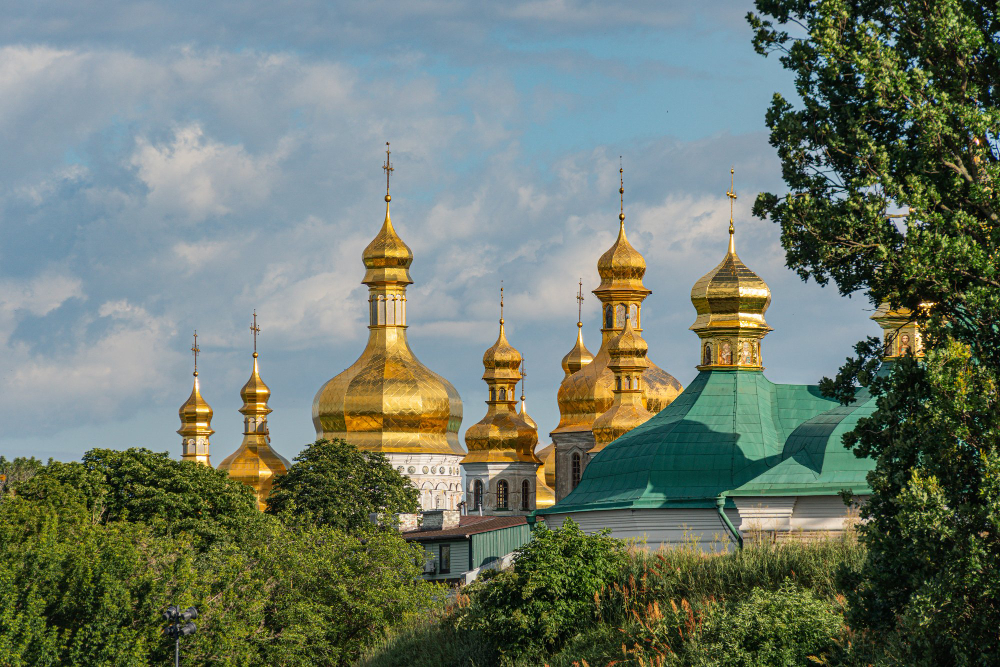
The Kyiv Pechersk Lavra — the Monastery of the Caves, founded in 1051 by the monk Anthony who began his religious life in a cave on the high bank above the Dnipro River — is the most important religious site in Ukraine and one of the most important in Eastern Orthodox Christianity: the complex of churches, bell towers, monastic buildings, and the underground cave system where the mummified remains of saints and monks who lived in the caves from the 11th century onward are preserved and venerated. The Upper Lavra, with its Great Lavra Bell Tower (the tallest bell tower in Ukraine, 96 metres, its green copper dome visible from across the river valley), the Dormition Cathedral (the 11th-century cathedral destroyed by the Nazis in 1941, rebuilt in 2000), and the Refectory Church — is the monastic complex as it appears to the world: the golden domes and the green copper roofs against the sky above the Dnipro, the image that defines Kyiv’s visual identity internationally. The Lower Lavra, on the slope below, contains the cave systems — the Near Caves and the Far Caves — where the monks lived and prayed in cells carved from the soft sandstone, and where the mummified saints are displayed in decorated glass caskets in the low, candlelit corridors of the cave church. The experience of walking through the cave complex — the warm light of the beeswax candles, the smell of incense, the low ceilings and the narrow passages, the relics in their cases in the side niches — is one of the most specifically Eastern Orthodox religious experiences available in the post-Soviet world, and entirely unlike anything in Western European religious tourism. Saint Sophia Cathedral, two kilometres northwest of the Lavra, is the other essential monument: the 11th-century cathedral built by Yaroslav the Wise in 1037, its interior mosaics (the golden mosaic of the Orant Virgin in the apse, the largest intact Byzantine mosaic programme outside Constantinople) among the most important surviving Byzantine artworks in the world.

Podil, Andriyivskyy Descent, and the City That Art Built
Kyiv’s urban structure divides between the Upper City (the plateau above the Dnipro where the medieval monasteries and the Soviet administrative buildings are concentrated) and the Lower City (Podil, the historic merchant and craft district on the riverbank below, connected to the upper plateau by the funicular that has been running since 1905 and by the Andriyivskyy Descent). Podil is the oldest continuously inhabited district of Kyiv — the merchant quarter that operated outside the princely citadel above and that has maintained a more human, more commercial, more bohemian character than the monumental upper city. The Contract House, the St Florus Monastery, the Interiors of the Bratsky Monastery — these are the heritage buildings of Podil — but the district’s current character is defined by its restaurant and bar culture, its independent bookshops, and the creative community that has made it the most culturally alive neighbourhood in Kyiv. Andriyivskyy Descent — the steep cobblestone street that connects the Upper City to Podil — is the most atmospheric street in Kyiv: the Baroque St Andrew’s Church (designed by Bartolomeo Rastrelli, the architect of the Winter Palace in St Petersburg) at its top, the street itself lined with gallery shops, artist studios, antique dealers, and the specific quality of a street that has been associated with Kyiv’s artistic and literary community since the 19th century. Mikhail Bulgakov, the author of The Master and Margarita, was born and grew up in a house on this street, and the Bulgakov Museum in his former home is one of the most interesting literary museums in Eastern Europe, preserving the apartment where the writer’s family lived and the social world of early 20th century Kyiv that his work depicts.

Ukrainian Food and the Restaurants That Were Making Kyiv a Culinary Destination
Kyiv’s food scene was, in the decade before 2022, developing into one of the most exciting in Eastern Europe: a generation of Ukrainian chefs who had trained abroad returned to Kyiv and began producing contemporary Ukrainian food that took the traditional cuisine — varenyky (the Ukrainian boiled dumplings filled with potato, cottage cheese, or cherries), borscht (the beet soup that Ukraine claims as its own and whose UNESCO Intangible Cultural Heritage recognition specifically acknowledges the Ukrainian tradition), salo (the cured pork fat eaten with rye bread and garlic that is the country’s most culturally specific food), the dumplings and fermented foods of the village tradition — and reframed it with modern technique in a way that made Ukrainian food visible internationally for the first time. Borscht is the dish that most requires reclamation from its association with Russian cuisine in the international imagination: the Ukrainian version — deeply red from fresh beets, enriched with a sour cream dollop, made with a specific combination of beet, cabbage, potato, carrot, onion, tomato, and pork that varies by region and by household — is a dish of considerable sophistication and regional variety, and eating it in Kyiv at a restaurant that makes it properly from fresh seasonal beets is the most direct available demonstration of what Ukrainian food culture has always contained and what the current conflict has made more internationally visible. The varenyky bars of the Podil district, the horilka (Ukrainian vodka flavoured with honey and pepper or with various herbs) served at the traditional restaurants, and the rich, cream-heavy pastry culture of the Kyiv confectioneries are the other coordinates of a food culture that was, before February 2022, being discovered by a growing number of visitors who came for the Lavra and stayed for the borsch and the varenyky and the fact that Kyiv was, at that point, one of the most affordable excellent cities in Europe.

Maidan, the Dnipro, and Kyiv’s Relationship with Its Own History
The Maidan Nezalezhnosti — Independence Square — is the central public space of Kyiv and the site of the two defining events of post-Soviet Ukrainian history: the Orange Revolution of 2004 (the mass protest that overturned a fraudulent presidential election and established Ukraine’s democratic trajectory) and the Euromaidan of 2013–2014 (the months-long mass demonstration that resulted in the removal of the Yanukovych government and the beginning of the current conflict’s political arc). Standing in the Maidan is standing in the place where Ukrainian civil society made its most significant political assertions in the modern period, and the square’s character — large, open, surrounded by the Soviet-era Bessarabska and the newer commercial buildings of the post-independence city — carries this history in a way that is impossible to miss if you know it and invisible if you don’t. The Dnipro River is the other defining feature of Kyiv’s geography: a river of considerable scale (one of the largest in Europe, 2,285 kilometres from the Valdai Hills to the Black Sea), with the upper city on its high right bank and the lower city spreading across the left bank floodplain, its islands and beaches visible from the embankment. The river walk along the Dnipro in the evenings — the light on the water, the boats, the view of the Lavra’s golden domes above the high right bank — was one of the simple urban pleasures of Kyiv before 2022 and will be again. The monument to the founders of Kyiv (the brothers Kyi, Schek, and Khoryv, and their sister Lybid, who according to tradition founded the city in the 5th century) stands at the highest point of the embankment, looking out over the river, and it communicates something simple and important: this city has been here for fifteen centuries, it has been contested and conquered and rebuilt and contested again, and it is still here.
Kyiv is a city that the world has learned a great deal about since February 2022, and most of what it has learned has been about the city’s capacity for resistance and its people’s willingness to stay and defend what is theirs. What the world knows less about is what it is defending: the Lavra’s golden domes above the Dnipro, the Byzantine mosaics of Saint Sophia, the cobblestone descent from St Andrew’s Church to the Podil riverbank, the borscht and the varenyky and the horilka of the restaurants that were, until recently, beginning to attract international food media attention. This blog is a record of what Kyiv is — what it was before the current conflict, what it remained during it, and what it will be again when the circumstances allow. It deserves to be understood in full. Go, when you can, and go knowing what you are going to see.
Leave a Reply