
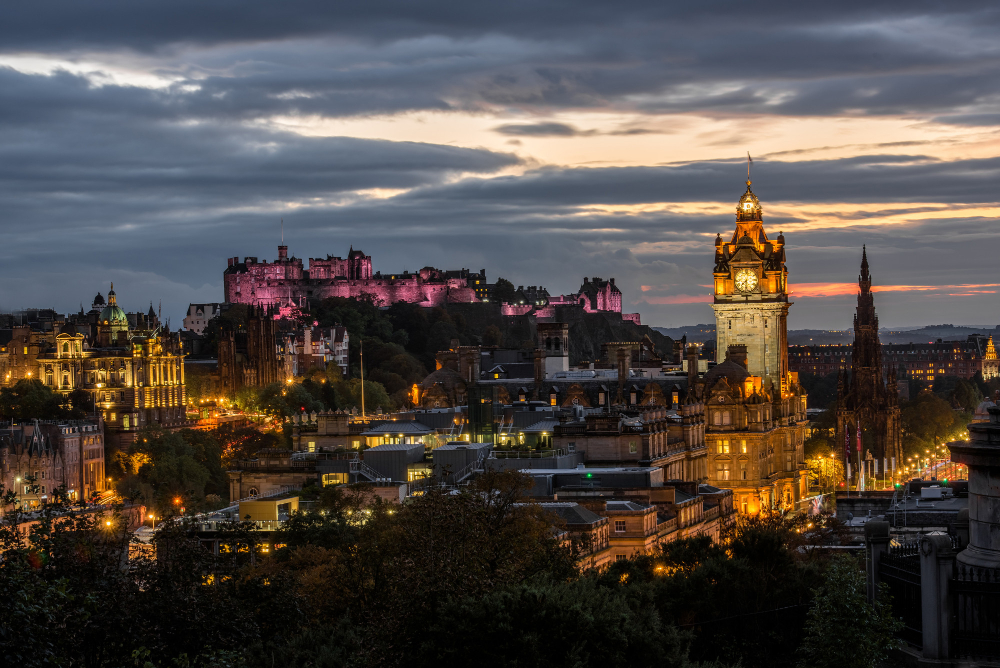
Most European capitals grew in layers, each century building over or around the last, blurring into something continuous. Edinburgh did something stranger. By the 18th century the medieval city on its ridge had become so overcrowded, filthy, and vertically stacked that the Scottish establishment decided to simply start again, building an entirely new, rationally planned Georgian town on the fields to the north, and leaving the old one largely as it was. The result is a city of two genuinely distinct characters sitting side by side and visible from each other across a valley: the Old Town, dark, steep, medieval, and built up rather than out because the ridge it sits on left nowhere else to go; and the New Town, wide, orderly, neoclassical, and laid out on a grid with a confidence that only a city with money and ambition could afford. Between and around them, extinct volcanoes and glacial crags push up through the urban fabric, so that you can be in a formal Georgian square one minute and climbing a genuine, if small, mountain the next. Edinburgh rewards walking slowly and looking up, because the city’s best details, carved stone, odd closes, gargoyles, hidden courtyards, are rarely at eye level on the main streets.
The Old Town: Closes, Vaults, and a City Built Vertically
The Royal Mile, running from Edinburgh Castle down to the Palace of Holyroodhouse, is the spine of the Old Town and, inevitably, its most crowded street, but its real character lies in the closes, the narrow alleys branching off it that give access to tenements and courtyards that were once some of the most densely populated urban spaces in Europe. Mary King’s Close, now preserved beneath later buildings and open as a guided underground tour, shows what that density actually meant, complete with the accounts of plague and squalid living conditions that the later New Town was built, in part, to escape. Edinburgh Castle, perched on the extinct volcanic plug that gives the whole city its defensible core, has been a fortress in some form for nearly a thousand years and holds the Scottish Crown Jewels and the Stone of Destiny, the stone on which Scottish and now British monarchs have traditionally been crowned; the one o’clock gun, fired daily except Sundays, is a small but reliably startling Edinburgh tradition. St Giles’ Cathedral, with its distinctive crown-shaped spire, anchors the middle of the Mile, and the Grassmarket and Victoria Street below, the latter said to have inspired Diagon Alley’s curved shopfronts, are worth the detour off the main route. The Old Town’s underground vaults, built into the arches of South Bridge and used historically for storage, workshops, and eventually illegal lodging for the city’s poorest residents, are now explored on several tour companies’ routes and give a genuinely atmospheric sense of the city’s less polished history, ghost stories aside.

The New Town: Georgian Order and the Mind Behind It
Cross Princes Street Gardens, the valley that was once a fetid loch drained to separate the two towns, and the character of Edinburgh changes completely. The New Town, begun in 1767 to a winning competition design by a 26-year-old architect named James Craig, is laid out on a strict grid of three parallel streets, Queen Street, George Street, and Princes Street, connected by a series of elegant squares, and built almost entirely in a restrained, confident neoclassical style using the local honey-coloured sandstone. It was, at the time, one of the most ambitious planned urban developments in Europe, and it remains remarkably intact. George Street, the grandest of the three, is lined with what were originally the city’s finest townhouses, many now housing banks, boutiques, and restaurants behind their original façades. Charlotte Square, at the western end, designed by Robert Adam, is considered one of the finest examples of Georgian architectural harmony in Britain, and Bute House, the official residence of Scotland’s First Minister, sits on its north side. The Scottish National Gallery and the Royal Scottish Academy sit at the foot of the Mound, the artificial hill built from Old Town excavation spoil that connects the two towns, and both are excellent, free, and rarely as crowded as they deserve to be avoided. Calton Hill, at the eastern end of the New Town, is an easy climb crowned with a scattering of half-finished and fully built monuments, including the unfinished National Monument, nicknamed Edinburgh’s Disgrace for running out of funding, and it offers, alongside Arthur’s Seat, the best panoramic views of the whole city.

Arthur’s Seat, the Volcano in the Middle of the City
Arthur’s Seat is the main peak of an extinct volcanic complex that last erupted around 350 million years ago, rising to 251 metres within Holyrood Park at the eastern edge of the city centre, and it is one of the more improbable things about Edinburgh that a genuine, if modest, hike with sweeping views over the Firth of Forth is a twenty-minute walk from the Royal Mile. Several routes lead to the summit, ranging from a steeper direct path to a gentler route around Dunsapie Loch, and on a clear day the views stretch across the city, the Forth, and out to the hills of Fife. The park also contains Salisbury Crags, a dramatic line of cliffs along a path known as the Radical Road, built in the 1820s partly as unemployment relief work and associated with Walter Scott, who reportedly suggested the project. The geology here is historically significant in its own right: James Hutton, often called the father of modern geology, studied the rock formations of Salisbury Crags in the 18th century to help develop his theories on the age of the earth, directly challenging the prevailing biblical timeline of the period. Go early or in the evening to avoid the heaviest crowds, wear proper shoes since the paths can be wet and slippery even in summer, and allow an hour or two depending on which route you take.

Food, Whisky, and the August Festival That Takes Over Everything
Scottish food has earned a better reputation in recent years than its old jokes suggest, and Edinburgh’s restaurant scene draws on excellent Scottish produce, particularly seafood from the North Sea and Atlantic coasts, game, beef, and soft fruit. Try a proper fish and chips from a chippy rather than a tourist-priced version on the Royal Mile, seek out langoustines and oysters where they are in season, and if haggis appears on a menu, a good version, served with neeps and tatties, is genuinely worth trying rather than dismissing. Whisky deserves serious attention here: Edinburgh has excellent whisky bars and shops with staff who will talk you through Highland, Speyside, Islay, and Lowland styles with real expertise, and a tasting flight is a better introduction than a single dram if you are new to it. The Scotch Whisky Experience near the castle offers a more packaged introduction for those who want the basics explained quickly. Every August, the city is transformed by the Edinburgh Festival Fringe, the largest arts festival in the world, running alongside the more formally curated Edinburgh International Festival, the Edinburgh International Book Festival, and others, turning nearly every available space, halls, pub back rooms, church crypts, the street itself, into a performance venue. It is exhilarating, exhausting, and extremely crowded, with accommodation prices rising sharply; if you want the festival experience, book well in advance and expect a city at full capacity. If you prefer Edinburgh quieter, visit outside August, when the same streets are calmer and considerably easier to enjoy at a slower pace.
Edinburgh’s two halves, the cramped vertical medieval city and the ordered Georgian one beside it, are not a contradiction so much as a demonstration of how a place can hold two different versions of itself at once and let visitors move between them within a single afternoon. Climb Arthur’s Seat for the view that puts both halves in context, walk the closes of the Old Town for the texture, walk Charlotte Square for the order, and if you are there in August, accept that the whole city is going to be loud, crowded, and extraordinary, and plan accordingly. Outside that month, give it the slow, unhurried attention that its details deserve.
Leave a Reply