
Hoi An is small enough that you can walk across its old centre in fifteen minutes and old enough that every one of those minutes passes through a different century. From the 15th to the 19th century it was one of the major trading ports of Southeast Asia, a place where Japanese and Chinese merchants wintered while they waited for the monsoon winds to carry their ships home, where Dutch and Portuguese traders came to buy silk and ceramics and spices, and where the Vietnamese who lived and worked among them absorbed what they brought and built a town that belonged to none of them entirely. Then the river silted up, the larger ships moved north to Da Nang, and Hoi An went quiet. That quiet is the reason it survives. The wooden shophouses, the tiled courtyards, the Chinese assembly halls, and the little Japanese covered bridge were not demolished because nobody had the money or the reason to demolish them, and by the time the outside world noticed, in the 1990s, the town was already one of the best-preserved trading ports in Southeast Asia. UNESCO listed it in 1999. Visitors have been arriving in growing numbers since, and the honest account of Hoi An today is that it is both genuinely beautiful and genuinely popular, and that the difference between a good visit and a disappointing one comes down almost entirely to timing and to how far you are willing to walk from the busiest lanes.

The Ancient Town: Walking It Before the Day Begins
The Ancient Town is a compact grid of lanes between the Thu Bon River and the old market, and its character changes completely with the hour. By mid-morning and again in the evening it fills with tour groups, and the narrow lanes become slow-moving streams of people with phones raised. At 6am, however, it belongs to the people who actually live there: the market women arranging produce, the noodle sellers lighting their burners, the shopkeepers sweeping the front steps of houses that have been in the same families for generations, the light low and soft on the yellow walls. Walk it then, before the ticket booths open, and you will understand why the place earned its listing. The Japanese Covered Bridge, a small tiled bridge with a pagoda-style roof thought to date from the late 16th or early 17th century, is the town’s emblem and is tiny, which surprises people who know it from photographs; it was built by the Japanese merchant community to link their quarter to the Chinese one across a stream, and a small temple is tucked into its northern side. The Chinese assembly halls, built by the Fujian, Cantonese, and other regional merchant communities, are more ornate than anything else in town, their courtyards filled with carved dragons, ceramic mosaics, and coils of incense hanging from the rafters. The merchant houses, such as the Tan Ky House, give a sense of how trading families lived: narrow at the street, deep behind, with internal courtyards that bring in light and let the house breathe in the heat. A combined ticket covers a choice of these sites, and it is worth spending on a few rather than rushing through all of them.
Lantern Nights, the Full Moon, and the River
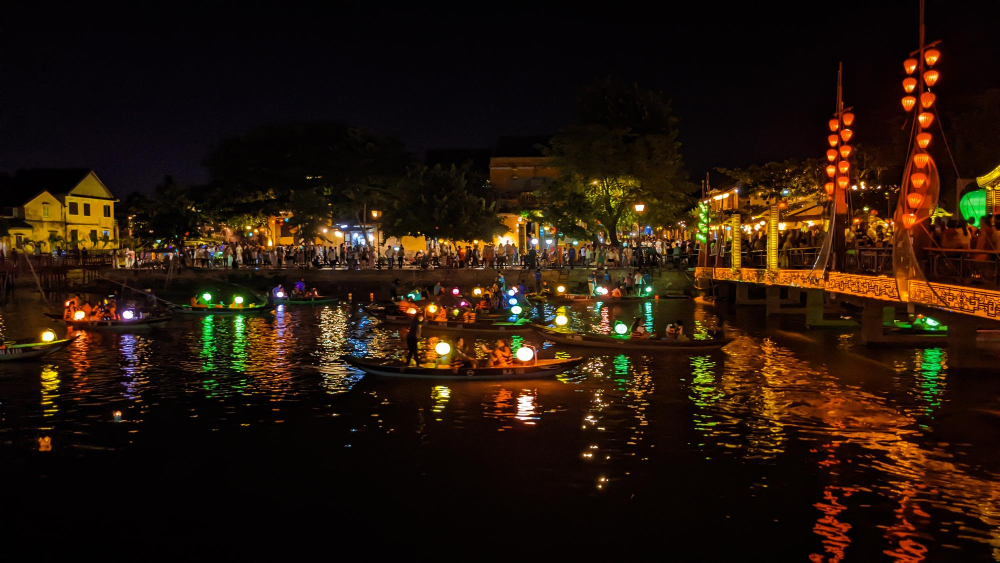
The lanterns are the reason many people come, and they deserve their reputation as long as you understand what you are looking at. Hoi An’s silk lanterns, glowing above shopfronts and along the river after dark, are a modern tradition grown out of an older practice of lighting lanterns for festivals, and they are made by local craftspeople who stitch silk over bamboo frames in shops across the old town. On the evening of the 14th day of each lunar month the town switches off its electric lights for a full-moon festival, and the streets fill with lanterns, music, and small cultural performances, while families release paper lanterns with a candle inside onto the river to carry wishes downstream. This is crowded, loud, and unashamedly popular, and it is also genuinely lovely in the way that shared public rituals can be. If you prefer the lanterns without the crush, go on an ordinary evening, cross to the far bank of the river, and watch the town light up from a small café terrace across the water. The boat hawkers will find you, and a short ride along the river in a small wooden boat, with a paper lantern floating beside you, costs very little and is one of those experiences that works precisely because it is simple. Note that the river rises during the autumn rains, and the lower streets of the old town flood most years between October and December; locals treat this as a seasonal fact of life, and visitors who arrive then should plan for wet feet and for shops and restaurants adapting with whatever is at hand.

The Food, Briefly, and the Tailors, Honestly
Hoi An’s cooking is covered at length in our regional Vietnamese food guide, so here is only what a visitor needs to know on the ground. Eat the dishes that belong to this place: cao lầu, the thick noodles with pork and herbs; the delicate shrimp dumplings known as white rose; and cơm gà, chicken and turmeric-yellow rice with herbs and pickles, the plain and perfect lunch of the region. Eat bánh mì from a busy stall rather than one with an English menu and a person calling you inside. For breakfast, try mì Quảng, the local turmeric noodles with a little broth and a crunch of rice cracker. The tailors are the other famous feature of the town, and they are worth taking seriously rather than treating as a novelty. Hoi An has hundreds of shops that will make a suit, a dress, or a coat in a day or two from fabric you choose, and the quality ranges from excellent to disappointing. Go in with a clear idea, bring a photograph or a garment you like, allow time for a second fitting, and ask to see work they have already done for other customers. The best shops are rarely the ones with the loudest touts. Be wary of any promise to make something perfect in twenty-four hours, and expect to pay a fair price for genuine skill.

Beyond the Old Town: Rice Fields, Beaches, and My Son
The old town is the centre of a much larger landscape, and the people who enjoy Hoi An most tend to leave it for part of each day. Cycling out through the rice paddies and vegetable plots on the edge of town is the simplest and most rewarding escape: within ten minutes of the old centre the roads give way to green fields, water buffalo, and farmers working by hand, and the village of Trà Quế is known for its herb and vegetable gardens, where visitors can join a farmer for a short lesson in planting or cooking. An Bàng beach, a short ride from town, is the usual choice for swimming and a long lunch with the sea in front of you, and it has a relaxed beach-bar atmosphere that is a pleasant change from the old town’s bustle; as everywhere on this coast, the sea can be rough outside the calmer months, so heed the flags. About 40 kilometres inland lies Mỹ Sơn, a UNESCO-listed complex of Hindu temples built by the Cham civilisation between roughly the 4th and 13th centuries, a quiet archaeological site of red-brick towers set in a green valley. It was badly damaged during the 20th-century war, but what survives is atmospheric and gives the town its deeper context: the Cham kingdom of Champa was the power on this coast long before the Vietnamese and the traders arrived. Go early, before the tour buses, and the site is calm and quiet.
When to Go and How to Visit Well
The best months are February to May, when the weather is warm and dry, the rains have not yet arrived, and the beaches and the countryside are at their most pleasant. June to August is hot and busy. September to January brings the rainy season, with heavy downpours, higher humidity, and the risk of flooding in the old town and of typhoons in the wider region; if you travel then, build flexibility into your plans and check the forecast. Book accommodation outside the old town, in a quieter guesthouse among the rice fields or near the beach, and cycle in. Buy the ancient-town ticket, but do not feel obliged to use every coupon. Eat where the locals eat. Take a morning walk before the crowds, an afternoon rest during the heat, and an evening by the river when the lanterns come on. And remember that the quiet that preserved this town was the result of hardship for the people who lived through it, so treat the place with a measure of the same care: do not touch what you should not, ask before photographing people at work, and spend your money in places that employ local families.
Hoi An is not an undiscovered secret, and anyone who tells you it is has not been in the evening. But it is still a town of real beauty, built by traders who came from far away and stayed long enough to make something lasting, and the people who live in it still use its lanes, its river, and its market as they have for centuries. Come with time, come early in the day, and let the lanterns come on in their own time.
Leave a Reply